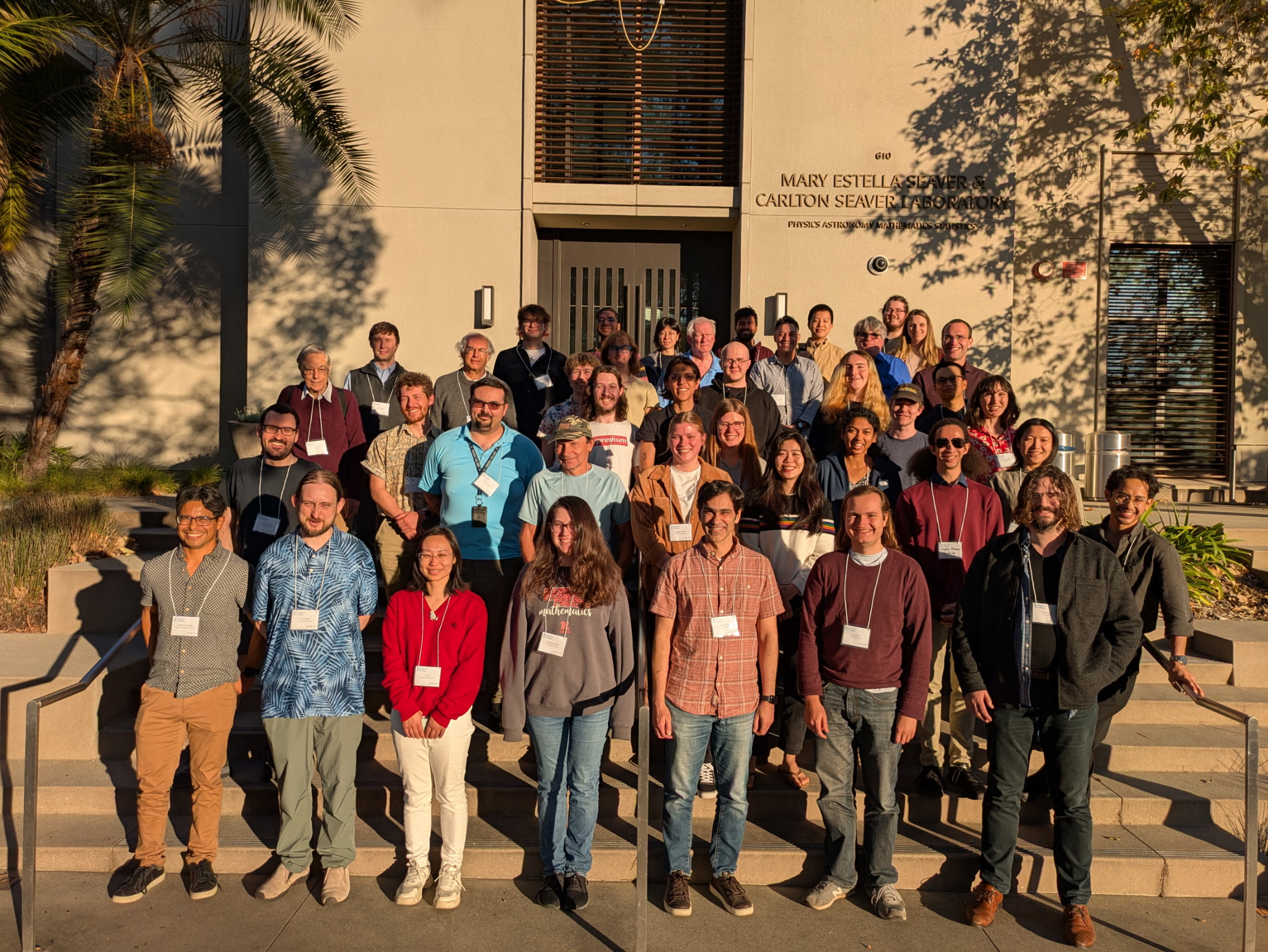
The 17th iteration of West Coast Operator Algebras Seminar (WCOAS) was held at Pomona College on December 6-7, 2025. The conference focuses on operator algebras (C* and von Neumann algebras) and noncommutative geometry, with applications to a wide range of areas, including ergodic theory, number theory, representation theory, and mathematical physics.
Program
The following speakers are currently confirmed. Titles and abstracts can be found below by expanding each speaker’s name, or on this file. All talks will be held in Estella Laboratory 1051 Argue Auditorium.
Saturday December 6
8:30-9:00 | Check-in and Registration with Coffee
9:00-9:40 | Marc A. Rieffel (University of California, Berkeley)
Title: Quotients by sub-C*-algebras, matricial seminorms, and Dirac triples.
Abstract: The null-space, B, of any Leibniz *-seminorm on a unital C*-algebra A, is a unital *-subalgebra of A. Thus the seminorm determines a norm on the quotient space, A/B. Surprisingly, the converse can be true. But there are confusingly many possibilities, even for finite metric spaces, and finite dimensional C*-algebras. And it makes a difference whether one is working over the real numbers or the complex numbers.I will give some examples; and I will sketch how working with matricial seminorms, and with Dirac triples, can somewhat clarify what is happening. But there is much that I do not understand.
9:50-10:30 | Manny Reyes (University of California, Irvine)
Title: Searching for noncommutative spectrum functors
Abstract: In classical algebra-geometry correspondences, the assignment turning an algebra into a space is a type of spectrum. Thus spectra of noncommutative algebras have been of interest for a long time in both ring theory and operator algebra. Because the spectrum typically provides a functor from commutative algebras to spaces, it is natural to ask whether we can extend it to a noncommutative spectrum functor.This talk will survey approaches to this problem, focusing especially on the case of operator algebras. I will discuss no-go theorems that place restrictions on possible spectrum functors for C*-algebras. I will introduce the discretization of a C*-algebra as an attempt to bypass these obstructions, with some partial positive results (joint with Chris Heunen). Finally I will discuss work-in-progress (joint with Konrad Aguilar) that may point to the eventual construction of a spectrum functor for C*-algebras.
10:30-10:50 | Coffee break with light snacks
10:50-11:30 | Melody Molander (The Ohio State University)
Title: A Well-Defined Jellyfish Algorithm for Affine E Subfactor Planar Algebras
Abstract: The jellyfish algorithm is an evaluation algorithm on subfactor planar algebras originally appearing in the work of Bigelow-Morrison-Peters-Snyder in 2012. Planar algebras are a collection of vector spaces along with multilinear maps corresponding to planar tangles. Planar algebras are often defined using diagrammatic generators and relations where the kth vector space is the linear combination of planar diagrams with k strands on the top and bottom that can be formed with the generators and nonintersecting strands. For a planar algebra to be a standard invariant of a subfactor, it must have a one-dimensional 0th vector space. This is often the toughest criteria to check that a planar algebra satisfies. The jellyfish algorithm is most commonly used to bound the dimension from above. In 2025, M. showed that the jellyfish algorithm can also be used to bound the dimension from below. In this talk, we will cover the basics of planar algebras and the jellyfish algorithm, then go over ways in which to use the algorithm. That is, we will first show how to use the jellyfish algorithm to show that the dimension of the 0th vector space is at most 1, then, using results from M. 2025, show that the jellyfish algorithm can be used to show that this vector space has dimension at least 1.
11:40-12:20 | Lara Ismert (University of New Mexico)
Title: Quantum Cuntz—Krieger algebras and how to see them
Abstract: Graph C*-algebras, and their finite, simple counterparts, Cuntz—Krieger algebras, have been coined as “C*-algebras you can see.” C*-algebras from quantum graphs, called quantum Cuntz—Krieger algebras, have been defined and studied in only the last five years, and they have not yet gained such a notable reputation. The underlying data of these algebras are quantum graphs, which have been studied through various lenses, all of which are equivalent in the setting of undirected graphs. In this talk, we recall three definitions of a quantum graph and give visualizations of all three definitions for a peculiar graph in the quantum case, the trivial quantum graph. We then discuss how to determine the quantum Cuntz—Krieger algebra arising from this graph both formally and from one of the visualizations. This talk is based on discussions with collaborators, personal observations, and Daws’s 2024 paper which formally connects the various notions of a quantum graph.
12:20-2:10 | Lunch on your own
2:10-2:50 | Isaac Goldbring (University of California, Irvine)
Title: On definability of C*-tensor norms
Abstract: Both the minimal and maximal tensor product norms are defined in an “extrinsic” way in terms of representations of the C*-algebras involved. One might wonder if there could be an intrinsic definition of these norm. For example, one might wonder if either the minimal or maximal tensor norm on a sum of simple tensors could be calculated by some sort of formula using norms of *-polynomials of the elements appearing in the simple tensors. In this talk, I explain how to use model theory to formulate a precise version of this latter question. We then discuss two variants of the question: the global version (where such a formula should hold for all C*-algebras, perhaps relative to some elementary class) and the local version (where such a formula should hold only for the pair of C*-algebras involved). I will explain that the answer to the global questions for both the maximal and minimal tensor product norms is negative in general, while in the local case, we give some examples where the answer is negative. The latter examples use the quantum complexity results MIP\(^*\)=RE and MIP\({}^\text{co}\)=coRE. The work presented in this talk is joint with Thomas Sinclair.
3:00-3:40 | Maggie Reardon (University of Colorado, Boulder)
Title: The HK- and AH-conjectures for certain groupoids constructed by Putnam
Abstract: Matui’s HK-conjecture proposes a connection between the homology of a nice enough étale groupoid and the \(K\)-theory of the associated reduced \(C^*\)-algebra. The HK-conjecture is not true in general and there are a number of counterexamples. The related AH-conjecture predicts an exact sequence involving the zeroth and first homology groups together with the abelianization of the topological full group. Unlike the HK-conjecture, no counterexamples are known for the AH-conjecture, though it remains unproven. Both conjectures are verified for a number of natural classes of groupoids, including AF groupoids. Putnam introduced a new class of groupoids in the paper titled “Some classifiable groupoid \(C^*\)-algebras with prescribed \(K\)-theory”. These new groupoids are related to AF groupoids and this prompts a natural question: does this new class of groupoids satisfy the HK- and AH-conjectures?
3:40--4:00 | Break
4:00-4:40 | Frédéric Latrémolière (University of Denver)
Title: A Gromov-Hausdorff-type hypertopology over the class of proper quantum metric spaces
Abstract: The field of noncommutative metric geometry has grown to provide a framework for the convergence, a la Gromov, of compact quantum metric spaces and various associated structures. However, the question of extending this theory to non compact quantum metric spaces remained difficult and unaddressed. Even defining the right class of quantum metric spaces as the realm of a Gromov-Hausdorff-like topology proved elusive. In this presentation, we will introduce our answer to this problem by defining a hypertopology on the class of proper quantum metric spaces. A proper quantum metric space generalizes boundedly compact locally compact metric spaces to the noncommutative world, borrowing from our earlier work on locally compact quantum metric spaces. The new hypertopology generalizes, at once, the propinquity between compact quantum metric spaces and the Gromov-Hausdorff distance between proper metric spaces, while enabling the presentation of new examples of convergence of noncommutative, noncompact quantum metric spaces as well. We hope this progress will start the exploration of the locally compact aspects of noncommutative metric geometry.
4:50-5:30 | Patrick DeBonis (Purdue University)
Title: The W* and C*-algebras of Similarity Structure Groups
Abstract: I will give an overview of Countable Similarity Structure (CSS) groups and the subclass of CSS* groups, which can be viewed as generalizations of Thompson's group V. This class includes the Higman-Thompson groups \(V_{d,r}\), the countable Röver-Nekrashevych groups \(V_d(G)\), and the topological full groups of subshifts of finite type of Matui. Then I will highlight several new properties of both their group von Neumann algebra and reduced group C*-algebra, including primeness of the CSS* group von Neumann algebra and C*-simplicity in certain cases. This is joint work with Eli Bashwinger.
5:45-7:00 | Reception with with complimentary drinks and light snacks courtesy of Pomona College
Estella Laboratory -- Kathy Sheldon Foyer (one floor above Estella 1051 and the elevator near Estella 1051 opens directly to this Foyer)Sunday December 7
8:30-9:00 | Check-in and Registration with Coffee
9:00-9:40 | Kathryn McCormick (California State University, Long Beach)
Title: Characterising twisted groupoid C*-algebras by Cartan semigroups
Abstract: Groupoid C*-algebras (and more generally, twisted groupoid C*-algebras) have become important in the classification program for C*-algebras, as well as providing a tractable subclass of C*-algebras that appear naturally in a variety of contexts. We know from Kumjian-Renault theory that a (reduced) twisted groupoid C*-algebra for a twist over G (an effective étale Hausdorff groupoid) can be characterised by algebraic data, namely the normaliser semigroup, the subalgebra it generates, and a conditional expectation; furthermore, the algebraic data can be used to reconstruct the groupoid twist. In this talk, I will define Cartan semigroups, a generalisation of the normaliser semigroup. I will also describe some results on how we can use Cartan semigroups to characterise twisted groupoid C*-algebras even when the underlying groupoid is not effective or the norm is not the reduced norm. This work is joint with Tristan Bice, Lisa Orloff Clark, and Ying-Fen Lin.
9:50-10:30 | David Gao (University of California, San Diego)
Title: Aspects of the ultraproduct method in von Neumann algebras
Abstract: In this talk, I will discuss several works by me and coauthors utilizing the ultraproduct method in von Neumann algebras. Specifically, I will discuss sequential commutation and its application to single generation and elementary equivalence of non-Gamma II1 factors; using inductive methods to build II1 factors with exotic properties; using the ultraproduct method to prove genericity of subfactors; finite-index subfactors of II1 factors with the super McDuff property; and disintegration in the context of elementary equivalence. The aim of this talk is to demonstrate some of the recent developments in the ultraproduct method as an invitation for further research in this direction. This talk is based on joint works with different groups of coauthors, including David Jekel, Srivatsav Kunnawalkam Elayavalli, Gregory Patchell, and Hui Tan.
10:30-10:50 | Coffee break with light snacks
10:50-11:30 | Hui Tan (University of California, Los Angeles)
Title: Title: Structure and non-isomorphisms of q-Araki-Woods factors
Abstract: Hiai’s construction of q-Araki-Woods factors generalizes both Shlyakhtenko’s free Araki-Woods factors and Bozejko-Speicher’s q-Gaussian algebras. In this talk, I will present that these q-Araki-Woods factors are strongly solid when almost periodic. Under a certain spectrum condition of the associated representation, I will show that q-Araki-Woods with infinite variables are not isomorphic to free Araki-Woods factors.
11:40-12:20 | Changying Ding (University of California, Los Angeles)
Title: Structure and non-isomorphisms of q-Araki-Woods factors
Abstract: Hiai’s construction of q-Araki-Woods factors generalizes both Shlyakhtenko’s free Araki-Woods factors and Bozejko-Speicher’s q-Gaussian algebras. In this talk, I will present that these q-Araki-Woods factors are strongly solid when almost periodic. Under a certain spectrum condition of the associated representation, I will show that q-Araki-Woods with infinite variables are not isomorphic to free Araki-Woods factors.
Registration
All participants, including invited speakers, are asked to register online. We ask those requesting travel support to please register by Oct 31st, 2025. Please fill out the registration form here.
Travel Information
Pomona College is located in Claremont, CA. If traveling by plane, it is recommended you either: (a) fly into Ontario International Airport (ONT) or (b) fly into Los Angeles International Airport (LAX). More information about traveling to Pomona College can be found at Pomona College’s Visiting page.
Accomodations
The following hotels are in close proximity to Pomona College:
- Doubletree Hotel, Claremont, limited number of rooms available at discounted rate for the nights of Dec. 5 and Dec. 6 at the Double Tree in Claremont that can be reserved by Nov. 15 using this link and Group Code: WCO
- Hote Casa 425 + Lounge
- AirBNB
Local Information
The map below show the location of serveral points of interest, including our recommendations for coffee, lunch, dinner, and local activities (this list is also available here). Use the map’s sidebar to toggle the items on and off.
Registered Participants
- Konrad Aguilar, (Pomona College)
- M. Ali Asadi-Vasfi, (Purdue University)
- Otto Baier, (Purdue)
- Samantha Brooker, (Virginia Tech)
- Adam Christopherson , (Baylor University )
- Arka Das, (Purdue University)
- Rolando de Santiago, (California State University, Long Beach)
- Patrick DeBonis, (Purdue University)
- Changying Ding, (UCLA)
- Raphael Esquivel, (Harvey Mudd )
- Gregory Faurot, (The Ohio State University)
- Priyanga Ganesan, (University of California San Diego)
- David Gao, (University of California San Diego)
- Stephan Ramon Garcia, (Pomona College)
- Forrest Glebe, (University of Hawai'i Manoa)
- Isaac Goldbring, (University of California, Irvine)
- Advith Govindarajan, (University of Illinois at Urbana Champaign)
- Yuqi Hu, (UC Irvine)
- Lara Ismert, (University of New Mexico)
- Arturo Jaime, (University of Hawai'i at Manoa)
- Benjamin Jones, (Arizona State University)
- Andre Kornell, (New Mexico State University)
- Ajay Kumar Karri, (Texas A&M University )
- Therese Landry, (University of California Santa Barbara)
- Frédéric Latrémolière, (University of Denver)
- Levi Lorenzo, (Fort Lewis College)
- Connor Mack Thompson, (Purdue University)
- Benjamin Major, (UCLA)
- Jose Manuel Barrientos Lopez, (Purdue University)
- Kathryn McCormick, (CSULB)
- Meenakshi McNamara, (Princeton)
- Jonathan Mellina, (University of Colorado, Boulder)
- Melody Molander, (The Ohio State University)
- So Nakamura, (University of California, Irvine)
- Igor Nikolaev, (St.John's University)
- Astrid Oppen, (CSULB)
- Cory Peters, (University of Oregon)
- Christopher N. Phillips, (University of Oregon)
- Jennifer Pi, (University of Oxford)
- Michael Poole, (Purdue University)
- John Quigg, (Arizona State University)
- Timothy Rainone, (Occidental College)
- Maggie Reardon, (University of Colorado Boulder)
- Manuel Reyes, (University of California, Irvine)
- Marc A. Rieffel, (U. C. Berkeley)
- Lei Sun, (Claremont Graduate University)
- Hui Tan, (University of California, Los Angeles)
- Caleb Williams, (University of Illinois at Chicago )
- Helen Wong, (CMC)
- Nicole Wu, (Harvey Mudd College)
- Zhiyuan Yang, (Texas A&M University)
- Adam M. Yassine, (Pomona College)
- Matthew Zediker, (University of Georgia)
Acknowledgements
The organizers are grateful for the support from National Science Foundation Grant DMS 2531278 and for the support from Pomona College.