Causal Theories of Mental Content
Historical Precedents
Advantages of Covariation Theories
Covariation Theories and the
Disjunction Problem
Functional
Role Semantics
Advantages of Functional Role Semantics
Problems
for Functional Role Semantics
Causal
Theories and Cognitive Science
It is a platitude, denied by very few, that minds causally interact with the world. Causal theories of mental content suppose that such causal connections not only facilitate the mind's interactions with the world, they provide the basis of mentality. A large part of understanding the nature of the mind is understanding how it comes to be aware of the world. Causal theories develop in the context of some or other representational theory of mind (RTM). A representational theory of mind holds that mental states have intentionality (are about the world) in virtue of a representational relationship holding between the mental state and the object. Causal theories of mental content hold that mental states represent the world in virtue of the sorts of causal relationships those states have within the mind and with the world. Historically, causal theories have been attractive to physicalists; philosophers interested in understanding all mental properties, states, and/or events (and all of existence) in terms of physical properties, states, and/or events. For such naturalistic philosophers the mind must be understood as purely physical in origin and nature. The main body of this article discusses the historical precedents of contemporary causal theories of mental content, the two major causal theories of mental content current in the philosophical literature. In each case the article outlines the theory, discusses its advantages and strengths, raises commonly perceived problems for the theory, and presents responses by proponents of the theory.
Though many theories of mental content are causal theories, not all theories of mental representation are causal in nature. For example, Locke supposes that ideas of primary qualities represented qualities in an object, not through reliable causation, but because they were similar (share the same properties). Contemporary causal theories of mental content have predecessors dating back to Book III of John Locke’s Essay Concerning Human Understanding, possibly Aristotle’s De Anima , or even to Plato’s Theatetus. Locke’s notion of secondary qualities (a quality or power of the object to cause particular ideas in us which bear no similarity to the object, e.x. color) looks very much like a contemporary causal theory based upon reliable causally mediated covariation (Cummins 1989). Aristotle’s discussion in Book II of De Anima suggests that, for example, color in the object is different from our sensations of color, which are nevertheless reliably caused by light hitting the object. Similarly, Plato’s analogy of perception as the matching of sensations caused by the world to impressions (knowledge) upon a ball of wax also suggests that Plato entertained the notion that causal connections allowed our minds to represent. Contemporary causal theories of mental representation have developed in the theoretical context of explanation in cognitive science. It can be helpful to view the intended role of such causal theories in computation explanations in cognitive science. However, contemporary causal theories can be understood independently of their role in cognitive science. Sidebar on Explanations in Cognitive Science
Theories
There are two general causal theoretical approaches to a theory of representation
in the contemporary literature.
Neither theoretical approach regarding the representation relation has gained general
acceptance. However, there are several
agreed-upon constraints for a theory of representation.
First, the representation relation must be consistent with the physicalistic
nature of cognitive science and science generally. Second, the relation
must be present and explanatory in accepted explanations within cognitive
science. (an appropriate characterization of "accepted" explanations is
somewhat controversial). Philosophers particularly would also like
to see the accepted theory of representation explain many of the widely
accepted properties of belief. Block (1986) and Fodor (1988) provide
excellent discussions of the potential problems, the solutions to which
many philosophers hope to find in a theory of mental representation.
One theoretic approach to articulating the representation relation, "Nomic (law-like) covariation" or "covariation," postulates a simple causal relationship between the object or property and the state that represents the object or property. The other approach, "functional role semantics," hypothesizes that a state has content in virtue of the state’s occupying a particular position in a complex web of causal relationships characterizing the cognizer’s functioning. Candidate content-fixing causal relationships include causal relationships within the cognizer (i.e., relations between brain states) and/or without (i.e., relations to the distal environment). Both functional role semantics and covariation theories satisfy the (above) first, physicalistic constraint by hypothesizing that a cognizer’s states represent the distal environment solely as a result of the specific sorts of causal connections had by those states. The theories diverge in terms of the specific causal relationships each emphasizes.
Covariation
Covariation theories hypothesize a state represents an object or property in
virtue of a causal connection between the object or property in the world and the state that represents that object
or property within the cognizer. Information theory as well as
work within a psychophysics inspire contemporary covariance theorists. Fodor, for instance, notes that
| ...there are circumstances such that red instantiations control ’red’ tokenings whenever those circumstances obtain; and it’s plausible that ’red’ expresses the property red in virtue of the fact that red instantiations cause ’red’ tokenings in those circumstances; and the circumstances are nonsemantically, nonteleologically, and nonintentionally specifiable. In fact, they’re psychophysically specifiable. (Fodor 1988, p.112) |
Covariation theories, as a result, seem to satisfy the
second constraint
upon theories of representation, i.e., that the relation must be present
and explanatory in accepted explanations within cognitive science.
For example, Hubel and Wiesel (1977) investigate the representational content
of cells in the striate (visual) cortex by monitoring the activity of those
cells looking for preferential relationships between the activity of
these cells and the presence of properties in the visual field.
A system’s states represent those objects and/or properties of the distal
world with which they covary according to covariation theories.
Specifically, covariation theories assign contents to states via some
version of the following definitions:
|
A state represents an object or property iff the probability of the object or property given the state equals 1. (Dretske 1981)
"...a symbol expresses a property if it's nomologically necessary that all and only instances of the property cause tokenings of the symbol." (Fodor 1988, p. 100)
For any state, call it Sc, and object or property, call it C: State Sc represents C iff the system tokens Sc when, only when, and because of C. (Cummins 1989) |
Advantages of Covariation Theories
Intuitive Appeal
The intuitive appeal of covariation theories stems from the idea that a cognizer
represents an object or property by being causally "in tune" with that object
or property. The causal connection provides a concrete connection between
the object/property and the state which represents it. It also insures
that the state represents elements of the cognizer's distal
environment.
Further, covariationists such as Jerry Fodor advocate the approach because covariation assigns content to individual states independent of how the cognizer operates upon those states (inferences it can make) and/or the content of other states with which the state might interact. Fodor refers to this assignment of content as "Punctate Content, or "atomic content." Among the advantages claimed by Fodor for punctate content is that it allows for content identity across individuals who have quite different theories regarding some object or property. Similarly, punctate content provides the only theory whereby people can refer to real objects even when they have great numbers of false beliefs about them. For instance, Fodor claims (1992) that Aristotle thought about and talked about the same things we refer to by "stars" even though he falsely believed stars to be relatively close and rotating around the Earth on glassy spheres.
Systematicity and Compositionality
Whereas the punctate content argument for covariation theories supposes that it is an advantage that the content of representational states is fixed in isolation from inferences in which the state might participate, the systematicity and compositionality argument suppose that covariation theories are in a better position to explain perceived truths about the combinatorial properties of language an concepts. Compositionality is the theory that the meaning of a complex expression in a language results from the meanings of its constitutive elements. Compositionality plays an central role in many linguistic theories, since its supposition for both language and thought provides a fairly straightforward explanation of the human ability to grasp an enormous number of different thoughts of varying complexity and their corresponding linguistic expressions. For instance, because we understand the individual elements like "cup" and "coffee", we understand the complex expressions "cup of coffee," "hot coffee," "coffee gives me the shakes," etc.. One explains our understanding by noting that the meaning of these complex sentences is built-up from the meaning of their constitutive elements. Furthermore, languages and thoughts seem to have a systematic structure to their compositionality. For instance, one seemingly cannot have the thought that "coffee has more kick that tea" without also being capable of thinking that "tea has more kick than coffee." Proponents of covariation theories (Fodor and Pylyshyn 1988, Fodor and McLaughlin 1991) argue that such seeming facts about thought and language are naturally explained by covariationist semantics.
Epistemology and Representation
A final perceived advantage for covariation approaches
lies in that they provide a clear-cut mechanism through which a cognizer
can come to know about an object or property in the world in virtue of their representational capacities. A cognizer that represents an object or
property in the environment does so insofar as the cognizer can reliably
detect the object’s presence. (Dretske, 1989)
Covariation Theories and the Disjunction Problem
The most widely discussed problem for covariation theories
is called the "Disjunction Problem". According to covariationists, a state
represents an object or property if the system tokens (enters into) that
state when confronted with the object or property and only when confronted
with that property. However, suppose that cognizer tokens a state, S
c, in all of it’s cat interactions. According to the when
clause of the covariationsist definition, the cognizer’s state appears to
represent cathood. Unfortunately, one night the cognizer tokens an S
c when seeing a skunk in the darkness. The only when clause
of the definition prima facie dictates that Sc never
really represented cathood simpliciter. Rather, the cognizer has always
represented a property that we can only describe using the disjunction, "cat
or skunk".
Illustrative Animation
The disjunction problem poses difficulties for covariation theories in two ways: First, the theory seems to dictate counterintuitive representational contents for states. If one has beliefs about cats, (e.x. cats are domesticated felines that have a number of distinct breeds), then covariation seems to dictate that those beliefs have always been about things having the property a cat or a skunk. Second, the disjunction problem seems to demonstrate that covariation cannot account for misrepresentation, since any seeming case of misrepresentation by a cognizer becomes a correct representation of a disjunctive property under covariation. In other words, one never mistakenly believes that one sees one's mother at the corner, one always correctly believes that "mother/other" is at the corner.
Theorists have explored a number of solutions to the disjunction problem. All of these solutions rely upon some form of the idealization strategy: A given solution will separate cases of the tokening (occurrence) of a state into two groups, one in which content is already fixed and representational error can occur (normal conditions), and the second class (ideal circumstances) in which content is fixed by perfect covariation. There are several important versions of this solution;
Ideal Conditions
To solve the disjunction problem,
one must modify the basic covariation theory so that the cognizer represents
"cat" and not "cat/skunk" despite occasionally mistaking
skunks for cats. Advocates of the ideal conditions solution to the disjunction problem
hold that under ideal perceptual conditions (i.e., in good
light, at close distance, etc.) one can distinguish cats from skunks. Thus,
they suggest cognizers represent cats as cats because of their discriminatory
capacities under ideal circumstances. Idealization in mainstream science is both the inspiration behind the covariationist’s
idealization strategy and its source of tacit plausibility. In normal cases
of scientific idealization theorists ignore certain negligible parameters
in real systems to formulate a law. The resulting law, though not strictly
true of any actual system, proves predicatively adequate, and quantifies a
real relation in actual physical systems. For example, real gases are
not composed of Newtonian molecules in that they are not point masses, nor
are their collisions perfectly elastic. Likewise, heat is not the only energy
source present in gases. In most cases, however, other parameters (like electromagnetic
forces) prove negligible. One idealizes away from such negligible parameters
to quantify the inverse relationship between, on the one side, the pressure
and volume of a gas, and on the other side, the temperature and number of
moles. Idealizing away from other parameters results in the ideal gas law:
PV = nRT.
The move toward idealization in response to the disjunction problem attempts to emulate noncontroversial cases of scientific idealization like the above-described ideal gas law. The basic idealization move defines representation as follows:
| A state Sc represents Cs as Cs iff under ideal circumstances the system tokens a Sc when, only when, and because Cs are present. |
On the idealization line, Sc represents cats as cats since, under ideal circumstances, the cognizer tokens Sc s when, only when, and because instances of cathood are present. State Sc does not represent "cat or skunk" because under ideal circumstances skunks do not cause the cognizer to token Sc. Such an idealization from error, admits the covariationist, breaks down in abnormal circumstances. Nevertheless, the idealization allows psychological laws to capture a real relation (the representation relation) in actual systems. Moreover, since most cases are close to ideal circumstances, psychological laws utilizing idealized covariation prove predicatively adequate.
The covariationist’s ideal conditions solution divides tokenings of a state by a system into content-imbuing (ideal) and content-fixed (malfunctioning/atypical) classes. Covariationists assert that one legitimately idealizes away from error because errors are coextensive with the cases of malfunction and/or atypical situations from which one legitimately idealizes. For example, if one pulls a weighted spring hard enough to bend or break the spring, it will no longer obey the standard harmonic oscillation equation. Such spring systems do not undermine the the basic physics of dampened harmonic oscillatory systems because the circumstances are such that the spring system cannot operate qua spring system. The same holds for cognitive malfunctions: One’s tokening of a Sc as a result of a amphetamine induced psychosis does not introduce disjunctive content because amphetamine induced psychosis is a case of mental malfunction.
Of course, all skunk-caused instances of Sc will not
trace their origins to malfunction. One could token a Sc
as a result of the same cat-like features prompting tokenings of S
c for cats. Dismissing such look-alike cases as malfunctioning
requires one also dismiss cat cases as malfunctions. All cognition
becomes malfunction, if one focuses exclusively upon malfunction in specifying
ideal conditions. Consider another example.

Subjects normally judge the right side of the above figure to have a much darker shade of purple than the left side. In fact, the surface reflectance of the purple areas of the figure remains uniform (it is all the same color of purple). Psychologists refer to the mistaken judgment as "the assimilation effect". Psychologists explain the assimilation effect by attributing the mistake to the pooling together of signals from several retinal cells. In most circumstances, pooling reduces equivocation (error or noise) that is due to false signals from individual retinal cells. However, when one closely intersperses the dark and light patterns throughout a visual field, pooling serves to inhibit or to excite cell firing, resulting in a misrepresentation of relative shading. So, a case of normal functioning--in fact, functioning that acts to reduce error--results in misrepresentation.
Covariance theorists respond to such normal functioning cases by appealing to atypical conditions. For instance, when the pressure upon a gas exceeds atmospheric level (1.013 x 10⁵ N/m2), or when its temperature becomes too great, the negligible parameters ignored by the idealized gas law become non-negligible. The predictive accuracy of the idealized gas law plummets, though the gas does not malfunction. Nevertheless, these cases do not count against the idealized gas law because the circumstances are atypical. The covariationist likewise claims that circumstances are perceptually atypical, that is, less than ideal, when the system tokens a Sc in response to a cat.
The covariationists’ move looks suspiciously circular unless they can specify an independent means of ruling out case of similar features as atypical. In other words, one must define ideal conditions so that malfunction and atypical circumstances prove coextensive with error. But one cannot avail oneself of the notion of error, nor of other intentional or semantic notions in formulating and motivating the definition. One must have a reason for labeling the skunk to Sc cases as less than ideal, and the reason cannot be that skunks cause cat tokens (Sc) in feature similarity cases. For example, in the movie "The Crying Game" an Irishman trying to escape from the IRA becomes romantically involved with a woman. However, much to the surprise of the Irish man (and the audience) this woman is actually a man. The reaction of the Irishman clearly shows he misrepresented the gender of his romantic partner. Yet, the Irishman did see his partner in good light, at close distance, etc.. The natural solution to this difficulty attempts to take advantage of the idea that there are conditions under which such a sex difference would not escape notice. However, in specifying such conditions as ideal conditions for this case, one must be guided in a circular manner by one’s knowledge of the property that the state actually represents.
Additionally, critics (Wallis 1994 and 1994a) argue that appealing to idealization to defeat the disjunction problem is strongly and negatively disanalogous with successful uses of idealization is science. For example, in order to explain misrepresentation in cases of malfunction or atypical circumstances, the covariationist must rely upon the content dictated by idealized covariation. When a skunk causes an Sc because bad lighting, the covariationist must suppose that Sc represents cats in order to explain why the person misrepresented the skunk as a cat. Thus, for the covariationist the results of the idealization are applicable in conditions which violate the presuppositions of the idealization. In contrast, when the pressure upon a gas exceeds atmospheric level (1.013 x 10⁵ N/m2), or when its temperature becomes too great, the negligible parameters ignored by the idealized gas law become non-negligible. In these atypical circumstances physicists will agree that the ideal gas law does not apply since the presuppositions of the idealization do not hold. Thus, while the mainstream use of idealization is limited to ideal or close to ideal circumstances, the covariationist cannot accept such limitations.
Learning Periods
Fred Dretske (1981, 1989) has suggested that content gets
fixed for a state during a learning period. In this period, cognizer
develops a perfect causal connection between the state and the object or
property with the help of an instructor who provides examples and corrections.
Once the learning period ends, the cognizer’s state has a fixed content and
tokenings of the state in cases where the object or property is not present
count as misrepresentations.
| A state Sc represents Cs as Cs iff in the learning situation the system tokens a Sc when, only when, and because Cs are present. |
Or, to adopt probabilistic formulation more consistent with Dretske's work:
| A state Sc represents Cs as Cs iff in the learning situation the probability of Cs given that the system tokens a Sc equals 1. |
Fodor (1988) and others have criticized this approach on two grounds. First, there seems to be no principled distinction between learning and non-learning periods. Hence, there are no grounds for calling some tokenings of the state content imbuing and others representing or misrepresenting. Second, even if one could specify a learning period, there seems to be no principled distinction between the univocal and disjunctive causal connections. Critics ask why, if one tokens Sc for both cat and skunk in the post-learning period, one shouldn’t suppose that the causal connection created in the learning period is between cats and Sc and not between cat/skunk and Sc ?
Philosophers have also offered the following standard criticisms of the learning periods approach. First, a cognizer can prima facie only represent those objects/properties for which it has had a learning situation. Thus, there on this approach there can be no innate knowledge. Second, cognizers do not seem to learn to identify properties and objects with perfect reliability as required by Dretske. Finally, since learning is a historical fact about a cognizer and a duplicate does not share one's learning history, the states of one's molecule for molecule duplicate would seem to lack the content had by one's own states. (Such examples duplicate examples appear in Burge, 1979, Cummins 1989, Davidson 1987, and Putnam 1975).
Teleological Accounts
Advocates of a teleological solution to the disjunction
problem, such as Dretske (1988), Millikan (1983 and 1986), Neander
(1995 and 1996), Papineau (1984), Shapiro (1992 and 1996), and Sterelny (1990) suggest that evolutionary history (evolution or learning for Dretske) determines content. For example,
a frog captures and eats any ambient moving dot in its visual field.
As a result, hungry frogs eat ball-bearings rolled in front of them.
Advocates of the teleological account claim that frogs misrepresent ball-bearings
as flies because the function of a frog’s visual cells is determined by the
uses of those cells responsible for a frog’s ability to propagate its genome,
i.e., uses involving fly capturing. Such an account would define
representation as follows:
| A state Sc represents Cs as Cs iff a function of tokens of Sc in the cognizer is to indicate when Cs are present. |
There is one caveat to the above definition in that notion of representation for teleosemanticists might be more like representing the presence of C at a time.
Two major distinctions appear among teleological theorists.: (1) whether the content-determining functions are those of
belief-generating mechanisms generically or of individual beliefs specifically and (2) whether the function of states should be assessed
relative to producers of those states, or to the consumers of the states.
For example, Millikan holds that adaptational history determines the function
(and hence, the content) of
specific beliefs. The content of the frog's visual state is
"fly," has an indicative function, in virtue of the state's past co-occurrence with flies.
Others (ex. Papineau) hold that selection
determines the function of belief-making mechanisms. Thus, the state means
fly because it was produced by a mechanism , the frog's visual system, the selective function of which
is to indicating the presence of objects in the distal environment. Second, some teleologists (ex. Millikan) emphasize the
function of the state for consumers of the the state that determines
content. Others suppose that it is the function of the producers of the
state that determines content. Thus, for Papineau it is the function of
the visual system (the producer of the state) that determines its content,
In contrast, the fact that Sc triggers the frog's
capturing mechanism (the consumer) that gives Sc it's
indicative function on Millikan's account.
Fodor (1988) criticizes teleological accounts on the ground
that evolution does not select with sufficient precision to account for typical
univocal content claims. If a frog represents ambient dots as "fly or
ball-bearing" in a fly-rich, ball-bearing-poor environment, then that disjunctive
representational content would account for the frog’s ability to propagate
its genome. Hence, claims Fodor, evolutionary history will not favor
"fly" over "fly-or-ball-bearing" as the content of frog visual cells.
Two other objections to teleological accounts appear in the literature. First, most artifacts (e.x., compact discs, SUVs, etc.) in the human environment were not present during a significant portion of human evolutionary history. As a result, advocates of teleological solutions to the disjunction problem must explain a huge percentage of the representational capacities of humans, including the representations of many ordinary objects like chairs or beer, by definition. Second, because teleological accounts appeal to the evolutionary history of a cognizer to explain representational abilities, any seeming representational abilities without such a history would not have representational content on the teleological account For example, if a molecule for molecule duplicate of Millikan where to spontaneously appear, it would seem to have all of her cognitive/representational abilities. Yet, on Millikan’s account, her exact double would not have any states with representational content. (Cummins, 1989, Davidson, 1987).
Asymmetric Dependence
Fodor’s (1990) asymmetric dependence theory suggests another
twist on the general idealization strategy. In addition to a nomic
connection between a state, Sc, and an object/property
(cathood) asymmetric dependence theories define representation in terms of
two counterfactual scenarios:
|
If, skunks cause Sc s, then (1) breaking the skunk to Sc connection does not break the cat to Sc and (2) breaking the cat to S c connection does break the skunk to Sc connection. |
As above, potentially troublesome cases get ruled out because there is a counterfactual set of conditions in which subjects can distinguish cats from skunks. Critics (Cummins, 1989 and Wallis 1995) argue that asymmetric dependence theories fare no better than other versions of nomic covariation. One difficulty is that the brain recognizes higher level concepts through the detection of features. As a consequence, it appears that there is no asymmetric dependence between cases, or worse, it goes the wrong way from fake to representation. For instance, if I find my car by looking for features x,y,z, then I can break the car to Scar connection by altering the appearance of my car. But that will not break the look-alike car to Scar connection (violating 2). If, on the other hand, I break the look-alike car to Scar connection (say by altering my beliefs about my car’s appearance), then it seems I do break the car to Scar connection (violating 1). Similar stories can be told in terms of the normal, albeit somewhat noisy, functioning of cells in the visual system. (Wallis 1995).
Other philosophers have forwarded other objections. Adams and Aizawa
(1997) have argued that Fodor's conditions commit him to the retinal projections
of properties and objects instead of the properties and objects
themselves. Antony and Levine (1991) as well Wallis (1995) have argued
that Fodor's theory runs counter to other aspects of his own account of
mentality.
Other Problems for Nomic Covariation
Semantic Reduction and Verificationism
In addition to the disjunction problem, another objection
challenges the ability of covariation theories to explain the representational
capacities of states with regard to objects/properties beyond low-level perceptual
properties (e.x. color). One can make one's best case for law-like
covariation determining the content of states representing low-level properties like red or zero-crossing.
One might even extend the notion to ordinary, medium sized objects/properties like table or
cow. However, at some point, probably early on one must suppose
that states represent properties and objects of a higher levels
of abstraction, at least one's like electron, in virtue of their being defined
(perhaps even implicitly) in
terms of the representational properties of lower level states.
| So what's proposed is a sort of foundationalism. The semantics of observation concepts is indeed special: First, in that--given an intact observer--the nomologically sufficient and semantically relevant conditions for their tokenings are specifiable 'purely externally'; viz., purely psychophysically. And second, in that all the other semantically relevant symbol/world linkages run via the tokening of observation concepts. 'Horse' means horse if 'horse' tokenings are reliably caused by tokenings of psychophysical concepts that are in turn caused by instantiations of psychophysical properties for which instantiations of horse are in fact causally responsible. The causal chain runs from horses in the world to horsy looks in the world to psychophysical concepts in the belief box to 'horse' in the belief box. 'Horse' means horse because that chain is reliable. (Fodor 1988, p.122) |
Robert Cummins (1989) objects to this strategy, claiming that the covariation of mental states with objects/properties requires that the cognizer represent heuristic information either implicitly or explicitly. Thus, covariation will not explain the representational properties of any states but the most primitive representational states. All higher level concepts from dog to democracy must get meaning through definition. At first glance, it seems plausible to suppose that states that represent high-level theoretical properties like electron get their meaning through definition in terms of lower level properties. After all, such properties and objects often have theoretical definitions. However, the failure of such semantic reductions has shaped the history of western philosophy and mathematics (Quine 1951). The logical positivists, for instance, held that the meaning of terms was just the conditions for their verification (the verificationalist theory of meaning). However, no generally accepted means of spelling out such conditions emerged. Covariation’s critics ask, "if the state one uses to represent crow gets its meaning from being defined in terms of lower level properties, then why does one have difficulty in articulating that definition in any but the most superficial sense?" Psychological research also appears to run contrary to semantic reductionism in that it indicates that object recognition and categorization are strongly influenced by perceptual features, the exact make-up of which is somewhat variable and fluid.
According to Cummins, mental states achieve covariation with cats because we already have explicitly represented or implicit knowledge about cats (ex. they are domesticated felines). Further, if covariation is not the simple, unmediated causal relationship between the property/object and the state, but rather the result of often complex causal interactions within the system, then this suggests that covariation is really just another instance of its competitor, functional role semantics.
Failure of Univocal Feature Detection for Low-Level Properties
Finally, some theorists like Kathleen Akins (1996) (also Churchland and Sejnowski 1992 and Wallis 1995) argue that the various cells that perform sensory transduction are not properly characterized as the sorts of feature detectors required by nomic covariation. Such sensory cells do not respond exclusively to the presence of some particular object or property, but can and do respond to other properties. Their responses are not all or nothing. Rather, they show "selective sensitivity" to properties in that they respond to a wider range of stimulus, but respond more strongly to certain stimuli. For example, rods and cones in the retina are often portrayed as representing a certain wavelength of light. The response curves of these cells in fact overlap dramatically.
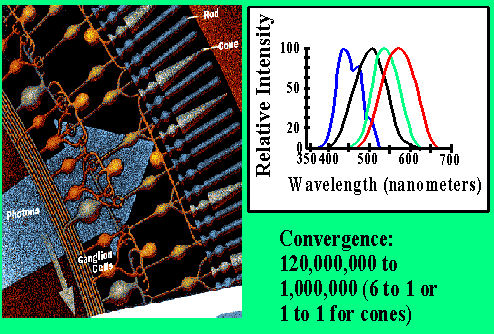
Thus, the same response
can be elicited from a red cone by similar levels of blue or green light.
Additionally, perception is riddled by often useful confabulations by the
sensory systems. For example, rod and cone activation is represented
by averages of pooled cells almost immediately in the visual system.
This has a good effect in that it eliminates noise from sources like body
heat, but can also lead to the assimilation effect
noted earlier. Similarly, the visual system compensates for the blind
spots in each retina were the cells leave the eye by "filling in" that area.
Covariationist intend their definition to capture a representation relation between states of the cognizer and objects and properties in the immediate distal environment. However, causal covariation occurs at a number of stages in the causal chain leading to the tokening of a state by a cognizer. At one extreme, all states of a cognizer happen when only when and because of the big bang. At the other extreme, Sc will covary with some set of patterns of retinal stimulation. Covariationists must find a way to rule out all links in the causal chain except the object/property in the immediate distal environment. For example, retinal stimulation patterns might be ruled out as candidates for content because of the multiplicity of patterns that cause a single state.
Another challenge for covariation theorists is to account for the content of states that intuitively seem to represent non-existing objects. If people have states that represent the property of being a unicorn, it would seem that those states must covary with unicorns. Since there are no unicorns with which a candidate state can covary, covariation theories do not seem to have a natural way to account for such representational abilities. Fodor (1990) has claimed that his asymmetric dependence theory can handle such cases. Another possible strategy for the covariationist would be to define non-existing objects.
Some philosophers, for example,
Searle (1980), Maudlin (1989), and BonJour (1991) have also argued against
covariation theories (in fact, against all causal theories) on the grounds that
these theories are satisfied in cases where for an internal perspective of an
agent, the agent lacks the necessary conscious awareness of content. For
these philosophers mental states that have intentionality (are about something)
have a qualitative aspect to them.
|
By 'consciousness' I mean subjective phenomenal states or modes of awareness. The most obvious examples of conscious episodes are sensory: tickles, pain, visual experiences, and so on. But they are not confined to straightforwardly sensory events. There is a certain phenomenology associated, for example, with my pondering the fact that ice is made of water. (Maudlin 1989, p.3) |
Searle (1980), for instance, argues that one can manipulate Chinese symbols having the appropriate causal connections to objects or properties in the world without thereby coming to understand Chinese.
Whereas covariationists focus upon a single causal connection in fixing content, advocates of functional role semantics (Block 1986 and 1987, Field 1977 and 1978, Harman 1987), suggest that the overall network of causal relations into which a state can enter fixes its content. Often causal roles are specified functionally/computationally. Versions of functional role semantics include "Conceptual Role Semantics," "Procedural Semantics," or "Inferential Role Semantics". There are two versions of this approach, designated "wide" or "long-armed" and "narrow" or "short-armed". Narrow functional role theorists limit the causal relations that determine content to those occurring between mental states. Wide theorists allow connections to the distal environment and even social contexts to delimit the content of a state.
Advantages of Functional Role Semantics
Functional role theories have several attractive features. For instance, functional role theorists do not need bifurcated accounts of representational content. Recall that the law-like connection between state and property required by covariation theories seemed the most plausible for low-level properties like color or shape. Therefore, covariationists had a difficulties accounting for a state's ability to represent higher-level properties and uninstantiated properties. Thus, theorists often offered alternative accounts of the representation of these properties (like definition through low-level properties). Functional role semanticists hypothesize that all states get their content in the same manner, via their functional role. Hence, functional role theorists avoid difficulties in explaining the representation of high-level and uninstantiated properties. They need not depend upon bifurcated accounts of representational properties.
Second, functional role theorists can easily accommodate the observation that changes in beliefs can result in changes in representational content, since changing beliefs will often change the functional roles of states. For example, prior to the discovery of Multiple Sclerosis theorists thought that Polio was the only disease associated fever, headache, stiff neck and back, muscle pain and tenderness, and, if there is involvement of the central nervous system, paralysis of essential muscles, such as those controlling swallowing, heartbeat, and respiration. As a result, researchers were baffled by the seeming vaccine resistant cases of Polio. The discovery of MS seemed to change the representational content of the mental representation of Polio.
Rationality Constraints on Belief Ascriptions
Finally,
functional role theorists can capture the intuition that in trying to understand
the representational content of another cognizer’s state, one is constrained
by the heuristic that the overall set of content ascriptions must "make sense,"
i.e., be consistent with the supposition that overall, the cognizer’s interactions
with the world are intelligent or rational. For example, if someone saw an
actual UFO the covariationist might well suppose that UFO was the content of
their representational state. However, if the person was the head of the
UFO-Sceptics association and had a theory debunking the UFO interpretation of
their experience. The functional role theorist would likely not attribute
the content "UFO" to the person's state.
Problems for Functional Role Theories
Semantic Holism
Theorists typically raise three distinct but related objections
to all versions of functional role semantics. First, to identify
particular states in disparate individuals as states having the same representational
content, functional role semantics prima facie requires that the states
have identical functional roles. Fodor (1992, 1987) among others has
termed this view Holism, about content (also Semantic Holism).
For example, suppose that it appears that both Bill and Bob believe that
"Wallis’ article is enlightening." That is, they both point to the
same article, proclaim that it is enlightening, assign it in their class,
etc.. However, the causal roles of their respective states differ in
a single respect; Bill believes "Wallis is a pompous know-it-all," while
Bob believes "Wallis is a precocious windbag." Prima facie,
Functional role semantics dictates that Bill’s belief that "Wallis’ article
is enlightening," has a different content than Bob’s. Similarly, people
with disparate cognitive or perceptual abilities seem to have disparate representational
contents. Thus, the theory appears to imply that the average human
has a different concept of traffic light than color blind humans.
Functional role semanticists generally adopt one of two responses to the above objection. One response strategy would prune the number and/or kind of causal or computational connections necessary for belief/content identity, thereby allowing for belief/content identity across individuals with somewhat different causal/computational roles. In the above case, differences in beliefs that are peripheral to the belief that "Wallis’ article is enlightening" would not necessarily constitute the basis for content non-identity.
While the just-rehearsed response has intuitive appeal, critics (Fodor 1988) point to the potential difficulties in distinguishing core (central) beliefs or other causal links from peripheral ones in a manner that is not hopelessly unsystematic and ad hoc. For instance, what causal connections (beliefs, desires, dispositions to take action, etc..) constitute the core of one’s belief that the colorless, tasteless, odorless liquid before one is water. Need one know, to take a case, of the existence of deuterium oxide (heavy water), make appropriate inferences with regard to D2O, discriminate between D2O and H2O, etc.. Including only analytic beliefs and corresponding inferences in the set of core beliefs and inferences is one common suggestion for distinguishing core from peripheral beliefs and inferences. Analytic truths are conceptual truths, those things that are true solely in virtue of the nature of the concept. Such a suggestion requires a real distinction between analytic beliefs and non-analytic (synthetic) beliefs. Many philosophers believe that Quine (1953/1970) has effectively undermined the robustness of such a distinction. Similarly, Stich (1983) argues that judgments of belief/content identity are not as intuitively precise as advocates of the analytic distinction would seem to predict.
The second response to the prima facie difficulty of intuitively identical content across differing functional roles claims that while such beliefs are in fact non-content-identical, they are strongly content-similar. The key concept here is the notion that belief identity is not a binary notion, but ranges from completely non-identical to completely identical (Cummins 1989). The strength (or weakness) of this response lies in its ability to accommodate the intuition that Bill’s and Bob’s beliefs have the same content while simultaneously acknowledging the theoretical constraint that differences in functional roles dictate differences in content.
Critics of Functional role semantics (ex. Fodor, 1988) argue that a graded notion of content identity, in addition to being counterintuitive, undermines the ability to formulate psychological generalizations and subsume particular cases under those generalizations. Cognitive science, they claim, would be reduced to the unworkable notion that Bill’s and Bob’s beliefs are, say, 97% content similar to the belief that Wallis’ article is enlightening and hence can be, say, 97% subsumed under generalizations regarding the belief that Wallis’ article is enlightening. Furthermore, Fodor (1992 and 2001) claims colloquial notions of belief similarity like, "His notion of mental representation is similar to mine," as well as their theoretical counterparts presuppose a notion of belief identity that he claims cannot be provided by holistic theories in any cases where beliefs diverge.
Content Fixing, Error, and Univocal Contents
A closely related objection to that of holism is the argument
that functional role theories have no non-arbitrary way either of fixing
content. Specifically, functional role semanticists either cannot distinguish
representational error from veridical representation, their theory results
in non-univocal content ascriptions, and/or the theory results in multiple
content ascriptions applying simultaneously to a given state. For example,
suppose that there are two worlds: one, call it Earth1 in
which there is no water, but in which D2O (or some chemically
different, but phenomenally similar substance) is plentiful; the other, call
it Earth2, where H2O is plentiful, but there is no
D2O. Bob grows up on Earth1, where he forms beliefs,
etc. about "water" as a result of interacting with D2O.
Bill grows up on Earth2, where he develops the exact same set of
beliefs, etc. about "water" as Bob, but based upon interacting with H
2O. If one is a narrow functional role theorist (using only causal
connections "internal" to the cognizer), then the two men must have identical
belief content when thinking about "water". They either form beliefs,
make inferences, etc., using states that represent what we would describe
using the disjunction, "H2O or D2O", or their states
represent both H2O and also D2O (as distinct entities)
simultaneously. Most philosophers consider the latter even less intuitively
plausible than the former.
Long arm or two factor theories can distinguish Bill’s and Bob’s beliefs since they include causal connections to environmental objects and/or properties. However, suppose that Bob also has the beliefs that "water is H2O," that "I live on Earth2," and "Earth 2 has only H2O on it’s surface." Is Bob representing "water" as D2O, but forming a false belief about the chemical structure of D2O? Or, is he representing "water" as H2O and forming false beliefs about the D2 O he finds in his environment. Critics assert that functional role semantics lacks the resources to disambiguate such scenarios.
Representational Structure
Finally, Fodor and LePore (1992), Fodor and McLaughlin
(1981), and Fodor and Plysyhyn (1988) raise the objection that functional
role semantics seems to violate truths about the structure of language and
thought like compositionality and systemativity. Compositionality is
the theory that the meaning of a complex expression in a language results
from the meanings of its constitutive elements. Compositionality
plays an central role in many linguistic theories, since its supposition for
both language and thought provides a fairly straightforward explanation of
the human ability to grasp an enormous number of different thoughts of varying
complexity and their corresponding linguistic expressions. For instance,
because we understand the individual elements like "cup" and "coffee", we
understand the complex expressions "cup of coffee," "hot coffee," "coffee
gives me the shakes," etc.. One explains our understanding by noting
that the meaning of these complex sentences is built-up from the meaning
of their constitutive elements.
Fodor and others claim that the functional role of a complex, non-idiomatic representation is not always a function of the functional roles of its parts. As a result, functional role theories can represent "cup of coffee" without having the concepts and associated inferences of "cup" or "coffee". This alleged aspect of functional role representation schemes would result in the possibility that one could represent and think about "cup of coffee," but could not represent or think about "iced coffee," "hot coffee," etc.. Nor could one understand or evaluate the sentence, "Coffee is the legal drug for which we exploit the people and natural resources of many third world countries."
Block (forthcoming ) has suggested that functional role semanticists can account for compositionality by adopting context-sensitive rules of use for words. That is, meanings of words can be understood as sets of inferences (functional roles) to to sentences containing the word and sets of inferences from sentences containing the word. Thus, "cup of coffee" does get its meaning from cup and is consistent with one understanding "iced coffee", etc.. Connectionists with commitments to functional roles and others (Smolensky 1991 and 1991a) have argued that connectionist systems can have constituents satisfying many of the criteria of compositionality without adopting traditional compositional representational frameworks.
Causal Theories and Cognitive Science
Cognitive science proceeds in the absence of a resolution of the debate over
theories of representation. However, the adoption of either nomic covariance
theories or functional role semantics does shape the research of individual
cognitive scientists. Many important debates in cognitive science have
resulted from allegiance to one or the other causal theory. For example,
one aspect of the connectionist vs Turing-compatible approaches computation
is that advocates of connectionist frameworks tend to adopt functional role
semantics, while advocates of Turing-compatible frameworks tend to adopt
nomic covariation. Similarly, the debate over the nature of mental
imagery was drawn along covariance vs functional role lines. It is
widely supposed that the adoption of one or the other theory of mental content
by the majority of cognitive scientists will have a profound impact on the
field.
Bibliography
- Akins, K. (1996) "Of Sensory Systems and the 'Aboutness' of Mental States." Journal of Philosophy. 93, 337-372.
- Allen, C. (forthcoming) "A Tale of Two Froggies." Canadian Journal of Philosophy.
- Almog, J., Perry, J. and Wettstein, H., eds. Themes from Kaplan , New York: Oxford University Press (1989).
- Aristotle. De Anima, in The Complete Works of Aristotle: The Revised Oxford Translation, Oxford: Oxford University Press (1984).
- Antony, L. & Levine, J. " The nomic and the robust," In (B. Loewer & G. Rey, eds) Meaning in Mind: Fodor and his Critics. Blackwell (1991).
- Beaney, M., ed. The Frege Reader, Oxford: Blackwell Publishers (1997)
- Berkeley, G. Principles of Human Knowledge, in M.R. Ayers, ed., Berkeley: Philosophical Writings, London: Dent (1975).
- Block, N. (ed.). Readings in Philosophy of Psychology, Vol. 2 , Cambridge, Mass.: Harvard University Press (1981).
- Block, N. (ed.) Imagery, Cambridge, Mass.: The MIT Press (1982).
- Block, N. "Mental Pictures and Cognitive Science," Philosophical Review 93 (1983): 499-542.
- Block, N. "Advertisement for a Semantics for Psychology," in P.A. French, T.E. Uehling and H.K. Wettstein, eds., Midwest Studies in Philosophy, Vol. X, Minneapolis: University of Minnesota Press (1986): 615-678.
- Block, N. "Functional Role and Truth Conditions," Proceedings of the Aristotelian Society suppl. (1987) 61: 157-181.
- Block, N. "Mental Paint and Mental Latex," in E. Villanueva, ed., Philosophical Issues, 7: Perception (1996): 19-49.
- Boghossian, P.A. "Content," in J. Kim and E. Sosa, eds., A Companion to Metaphysics, Oxford: Blackwell Publishers Ltd. (1995): 94-96.
- BonJour, L. "Is Thought a Symbolic Process?" Synthese 89 (1991) 331-352.
- Burge, T. "Individualism and the Mental," in P.A. French, T.E. Uehling and H.K. Wettstein, eds., Midwest Studies in Philosophy, Vol. IV, Minneapolis: University of Minnesota Press (1986): 73-121.
- Chalmers, D. The Conscious Mind, New York: Oxford University Press (1996).
- Chalmers, D. "Connectionism and Compositionality: Why Fodor and Pylyshyn Were Wrong," Philosophical Psychology 6 (1993): 305-319.
- Chisholm, R. and Sellars, W. "The Chisholm-Sellars Correspondence on Intentionality," in H. Feigl, M. Scriven and G. Maxwell, eds., Minnesota Studies in the Philosophy of Science, Vol. II, Minneapolis : University of Minnesota Press (1958): 529-539.
- Chomsky, N. Aspects of the Theory of Syntax, Cambridge, Mass.: The MIT Press (1965).
- Churchland, P.M. "Eliminative Materialism and the Propositional Attitudes," Journal of Philosophy 78 (1981): 67-90.
- Churchland, P.M. "On the Nature of Theories: A Neurocomputational Perspective," in W. Savage, ed., Scientific Theories: Minnesota Studies in the Philosophy of Science, Vol. 14, Minneapolis: University of Minnesota Press (1989): 59-101.
- Churchland, P and Sejnowski, T (1992) The Computational Brain. Cambridge, MA: MIT Press.
- Cummins, R (1989) Meaning and Mental Representation. Cambridge: MIT Press.
- Cummins, R. (1996) Representations, Targets, and Attitudes. Cambridge: MIT Press.
- Davidson, D. "Radical Interpretation," Dialectica 27 (1973): 313-328.
- Davidson, D. "Belief and the Basis of Meaning," Synthese 27 (1974): 309-323.
- Davidson, D. "Thought and Talk," in S. Guttenplan, ed., Mind and Language, Oxford: Clarendon Press (1975): 7-23.
- Davidson, D. "Rational Animals," Dialectica 4 (1982): 317-327.
- Davidson, D. "Knowing One's Own Mind", Proceedings of the American Philosophical Association (1987).
- Dennett, D. Content and Consciousness, London: Routledge and Kegan Paul (1969).
- Dennett, D. "The Nature of Images and the Introspective Trap," pages 132-141 of Dennett 1969, reprinted in Block 1981 (1981): 128-134.
- Dennett, D. The Intentional Stance, Cambridge, Mass.: The MIT Press (1987).
- Dennett, D. "True Believers: The Intentional Strategy and Why it Works," in Dennett 1987 (1987a): 13-35.
- Dennett, D. "Reflections: Real Patterns, Deeper Facts, and Empty Questions," in Dennett 1987 (1987b): 37-42.
- Dennett, D. "Quining Qualia," in A.J. Marcel and E. Bisiach, eds., Consciousness in Contemporary Science, Oxford: Clarendon Press (1988): 42-77.
- Dennett, D. "Real Patterns," The Journal of Philosophy LXXXVII (1991): 27-51.
- Devitt, M. Coming to Our Senses: A Naturalistic Program for Semantic Localism, Cambridge: Cambridge University Press (1996).
- Dretske, F. Seeing and Knowing, Chicago: The University of Chicago Press (1969).
- Dretske, F. Knowledge and the Flow of Information, Cambridge, Mass.: The MIT Press (1981).
- Dretske, F. Explaining Behavior: Reasons in a World of Causes , Cambridge, Mass.: The MIT Press (1988).
- Dretske, F. "The Need to Know," in Lehrer, K. and Clary, M. eds., Theory of Knowledge: The State of the Art Tucson, AZ: University of Arizona Press (1989).
- Dretske, F. Naturalizing the Mind, Cambridge, Mass.: The MIT Press (1994).
- Evans, G. The Varieties of Reference, Oxford: Oxford University Press (1982).
- Field, H. "Logic, Meaning, and Conceptual Role," Journal of Philosophy (1977) 74: 379-409.
- Field, H. "Mental representation," Erkenntnis 13 (1978): 9-61.
- Flanagan, O. Consciousness Reconsidered, Cambridge, Mass.: The MIT Press (1992).
- Fodor, J.A. The Language of Thought, Cambridge, Mass.: Harvard University Press (1975).
- Fodor, J.A. "Propositional Attitudes," The Monist 61 (1978): 501-523.
- Fodor, J.A. Representations, Cambridge, Mass.: The MIT Press (1981).
- Fodor, J.A. "Introduction," in Fodor 1981 (1981a): 1-31.
- Fodor, J.A. "Methodological Solipsism Considered as a Research Strategy in Cognitive Psychology," in Fodor 1981 (1981b): 225-253.
- Fodor, J.A. "The Present Status of the Innateness Controversy," in Fodor 1981 (1981c): 257-316.
- Fodor, J.A. "Cognitive Science and the Twin-Earth Problem," Notre Dame Journal of Formal Logic 23 (1982): 98-118.
- Fodor, J.A. Psychosemantics, Cambridge, Mass.: The MIT Press (1987).
- Fodor, J. and Pylyshyn, Z. (1988). "Connectionism and Cognitive Architecture: A Critical Analysis," in Cognition. 28: 3-71.
- Fodor, J.A. A Theory of Content and Other Essays, Cambridge, Mass.: The MIT Press (1990a).
- Fodor, J.A. "Psychosemantics or: Where Do Truth Conditions Come From?" in W.G. Lycan, ed., Mind and Cognition: A Reader, Oxford: Blackwell Publishers (1990), (1990b): 312-337.
- Fodor, J. and McLaughlin, B. (1991). "Connectionism and the Problem of Systematicity: Why Smolensky's Solution Doesn't Work," in T. Horgan and J. Tienson (eds.) Connectionism and the Philosophy of Mind. Boston: Kluwer Academic Publishers.
- Fodor, J. and LePore, E. Holism: A Shoppers’ Guide. Oxford: Blackwell. (1992).
- Fodor, J.A. The Elm and the Expert, Cambridge, Mass.: The MIT Press (1994).
- Fodor, J. The Mind Doesn’t Work That Way. Cambridge: MIT Press. (2001).
- Fodor, J.A. and Pylyshyn, Z. "How Direct is Visual Perception?: Some Reflections on Gibson?s ?Ecological Approach?,"Cognition 9 (1981): 207-246.
- Fodor, J.A. and Pylyshyn, Z. "Connectionism and Cognitive Architecture: A Critical Analysis," Cognition 28 (1988): 3-71.
- Frege, G. The Foundations of Arithmetic, trans. J.L. Austin, New York: Philosophical Library (1953).
- Frege, G. "On Sinn and Bedeutung" (1892) in Beany 1997: 151-171.
- Frege, G. "Thought" (1918) in Beany 1997: 325-345.
- Geach, P. Mental Acts: Their Content and Their Objects, London: Routledge & Kegan Paul (1957) .
- Goldman, A. "The Psychology of Folk Psychology," Behavioral and Brian Sciences 16 (1993): 15-28.
- Goodman, N. Languages of Art (2nd ed.), Indianapolis: Hackett (1976).
- Grice, H.P. "Meaning," Philosophical Review, 66 (1957): 377-388; reprinted in Studies in the Way of Words, Cambridge, Mass.: Harvard University Press (1989): 213-223.
- Harman, G. Thought, Princeton: Princeton University Press (1973).
- Harman, G. "(Non-Solipsistic) Conceptual Role Semantics," in E. Lepore, ed., New Directions in Semantics, London: Academic Press (1987): 55-81.
- Harman, G. "The Intrinsic Quality of Experience," in J. Tomberlin, ed., Philosophical Perspectives 4: Action Theory and Philosophy of Mind , Atascadero: Ridgeview Publishing Company (1990): 31-52.
- Haugeland, J. "Analog and analog," Philosophical Topics 12 (1981): 213-226.
- Heil, J. "Being Indiscrete," in J. Greenwood, ed., The Future of Folk Psychology, Cambridge: Cambridge University Press (1991): 120-134.
- Horgan, T. and Tienson, J. Connectionism and the Philosophy of Psychology, Cambridge, Mass: The MIT Press (1996).
- Horst, S. Symbols, Computation, and Intentionality, Berkeley: University of California Press (1996).
- Hubel, D. and Wiesel, T. (1977) "Ferrier Lecture: Functional Architecture of Macaque Monkey Visual Cortex." Proc. R. Soc. Lond. (1977) 198:1-59.
- Hume, D. A Treatise of Human Nature, L.A. Selby-Bigge, ed., revised P.H. Nidditch, Oxford: Oxford University Press (1978).
- Jackendoff, R. Computation and Cognition, Cambridge, Mass.: The MIT Press (1987).
- Johnson-Laird, P.N. Mental Models, Cambridge, Mass.: Harvard University Press (1983).
- Johnson-Laird, P.N. and Wason, P.C. Thinking: Readings in Cognitive Science, Cambridge University Press (1977).
- Kaplan, D. "Demonstratives," in Almog, Perry and Wettstein 1989 (1989): 481-614.
- Kosslyn, S.M. Image and Mind, Cambridge, Mass.: Harvard University Press (1980).
- Kosslyn, S.M. "The Medium and the Message in Mental Imagery," in Block 1982 (1982): 207-246.
- Kosslyn, S. Ghosts in the Mind?s Machine, New York: W.W. Norton & Co. (1983).
- Kosslyn, S.M. and Pomerantz, J.R. "Imagery, Propositions, and the Form of Internal Representations," Cognitive Psychology 9 (1977): 52-76.
- Leeds, S. "Qualia, Awareness, Sellars," Noûs XXVII (1993): 303-329.
- Lerdahl, F. and Jackendoff, R. A Generative Theory of Tonal Music , Cambridge, Mass.: The MIT Press (1983).
- Levine, J. "On Leaving Out What It?s Like," in M. Davies and G. Humphreys, eds., Consciousness, Oxford: Blackwell Publishers (1993): 121-136.
- Levine, J. "On What It Is Like to Grasp a Concept," in E. Villanueva, ed., Philosophical Issues 6: Content, Atascadero: Ridgeview Publishing Company (1995): 38-43.
- Lewis, D. "Analog and Digital," Noûs 5 (1971): 321-328.
- Lewis, D. "Radical Interpretation," Synthese 23 (1974): 331-344. (Reprinted, with Postscript, in Lewis 1983: 108-121.)
- Lewis, D. Philosophical Papers, Vol. I, New York: Oxford University Press (1983).
- Loar, B. Mind and Meaning, Cambridge: Cambridge University Press (1981).
- Locke, J. An Essay Concerning Human Understanding, P.H. Nidditch, ed., Oxford: Oxford University Press (1978).
- MacDonald, C. and MacDonald, G. Connectionism: Debates on Psychological Explanation, Oxford: Blackwell Publishers (1995).
- Marr, D. Vision, New York: W.H. Freeman and Company (1982).
- Martin, C.B. "Proto-Language," Australasian Journal of Philosophy 65 (1987): 277-289.
- Maudlin, T. "Computation and Consciousness," Journal of Philosophy 86 (1989) 407-432.
- McCulloch, W.S. and Pitts, W. "A Logical Calculus of the Ideas Immanent in Nervous Activity," Bulletin of Mathematical Biophysics 5 (1943): 115-33.
- McGinn, C. "The Structure of Content," in A. Woodfield, ed., Thought and Content, Oxford: Oxford University Press (1982): 207-258.
- McGinn, C. Mental Content, Oxford: Blackwell Publishers (1989).
- McGinn, C. "Content and Consciousness," in C. McGinn, The Problem of Consciousness, Oxford: Blackwell Publishers (1992): 23-43.
- Millikan, R. Language, Thought and other Biological Categories , Cambridge, Mass.: The MIT Press (1984).
- Millikan, R. "Thought Without Laws: Cognitive Science Without Content." Philosophical Review (1986) 95:47-80.
- Neander, K. "Misrepresenting and Malfunctioning." Philosophical Studies 79:109-41 (1995).
- Neander, K. "Dretske's Innate Modesty," in Australasian Journal of Philosophy 74:258-74 (1996).
- Newell, A. and Simon, H.A. Human Problem Solving, New York: Prentice-Hall (1972).
- Newell, A. and Simon, H.A. "Computer Science as Empirical Inquiry: Symbols and Search," Communications of the Association for Computing Machinery 19 (1976): 113-126.
- Osherson, D.N., Kosslyn, S.M. and Hollerbach, J.M. Visual Cognition and Action: An Invitation to Cognitive Science, Vol. 2, Cambridge, Mass.: The MIT Press (1990).
- Papineau, D. "Representation and Explanation," in Philosophy of Science 51:550-72 (1984).
- Papineau, D. Reality and Representation, Oxford: Blackwell Publishers (1987).
- Peacocke, C. Sense and Content, Oxford: Clarendon Press (1983).
- Peacocke, C. "Perceptual Content," in Almog, Perry and Wettstein 1989 (1989): 297-329.
- Peacocke, C. "Scenarios, Concepts and Perception," in T. Crane, ed., The Contents of Experience, Cambridge: Cambridge University Press (1992): 105-35.
- Pinker, S. Learnability and Cognition, Cambridge, Mass.: The MIT Press (1989).
- Port, R. and Van Gelder, T. Mind as Motion: Explorations in the Dynamics of Cognition, Cambridge, Mass.: The MIT Press (1995).
- Putnam, H. "The Meaning of Meaning," in Philosophical Papers, Vol. 2, Cambridge: Cambridge University Press (1975): 215-71.
- Pylyshyn, Z. "The Rate of ?Mental Rotation? of Images: A Test of a Holistic Analogue Hypothesis," Memory and Cognition, 7 (1979): 19-28.
- Pylyshyn, Z. "Imagery and Artificial Intelligence," in Block 1981 (1981a): 170-194.
- Pylyshyn, Z. "The Imagery Debate: Analog Media versus Tacit Knowledge," Psychological Review 88 (1981b): 16-45.
- Pylyshyn, Z. Computation and Cognition, Cambridge, Mass.: The MIT Press (1984).
- Quine, W. "Two Dogmas of Empricism" in Philosophical Review 60: 20-43 (1951).
- Quine, W. From a Logical Point of View. Cambridge: Harvard University Press. (1953).
- Quine, W. Word and Object. Cambridge: MIT Press. (1960).
- Raffman, D. "The Persistence of Phenomenology," in T. Metzinger, ed., Conscious Experience, Paderborn: Schöningh/Imprint Academic (1995): 293-308.
- Ramsey, W., Stich, S. and Garon, J. "Connectionism, Eliminativism and the Future of Folk Psychology," Philosophical Perspectives 4 (1990): 499-533.
- Rey, G. "Introduction: What Are Mental Images?" in Block(1981): 117-127.
- Rey, G. "Sensations in a Language of Thought," in E. Villaneuva, ed., Philosophical Issues 1: Consciousness, Atascadero: Ridgeview Publishing Company (1991): 73-112.
- Rumelhart, D.E. "The Architecture of the Mind: A Connectionist Approach," in M.I. Posner, ed., Foundations of Cognitive Science, Cambridge, Mass.: The MIT Press (1989): 133-159.
- Rumelhart, D.E. and McCelland, J.L. Parallel Distributed Processing, Vol. I, Cambridge, Mass.: The MIT Press (1986).
- Schiffer, S. 1987. Remnants of Meaning, Cambridge, Mass.: The MIT Press (1987).
- Schiffer, S. "Introduction to the Paperback Edition," in Meaning , Oxford: Clarendon Press (1988): xi-xxix.
- Searle, J. "Minds, Brians, and Programs," Brain and Behavioral Sciences 3 (1980) 417-457.
- Searle, J.R. Intentionality, Cambridge: Cambridge University Press (1983).
- Searle, J.R. The Rediscovery of the Mind, Cambridge, Mass.: The MIT Press (1990).
- Sellars, W. "Empiricism and the Philosophy of Mind," in K. Gunderson, ed., Minnesota Studies in the Philosophy of Science, Vol. I, Minneapolis: University of Minnesota Press (1956): 253-329.
- Shapiro, L. 1992. Darwin and disjunction: Foraging theory and univocal assignments of content. Philosophy of Science Association 1992, 1:469-80.
- Shapiro, L. 1996. Representation from bottom to top. Canadian Journal of Philosophy 26:523-42.
- Shapiro, L. "Multiple Realizations," The Journal of Philosophy , vol. 97, no. 12, pp. 635-654, (2000).
- Shepard, R.N. and Cooper, L. Mental Images and their Transformations , Cambridge, Mass.: The MIT Press (1982).
- Shoemaker, S. "Qualities and Qualia: What?s in the Mind?" Philosophy and Phenomenological Research 50 (1990): 109-31.
- Smolensky, P. "On the Proper Treatment of Connectionism," Behavioral and Brain Sciences, 11 (1988): 1-74.
- Smolensky, P. "Connectionist Modeling: Neural Computation/Mental Connections," in L. Nadel, L.A. Cooper, P. Culicover and R.M. Harnish, eds., Neural Connections, Mental Computation Cambridge: The MIT Press (1989): 49-67.
- Smolensky, P. "Connectionism, Constituency, and the Language of Thought," in G. Rey and B. Loewer (eds.) Meaning in Mind . Cambridge: Blackwell (1991) : 201-227.
- Smolensky, P. "The Constituent Structure of Connectionist Mental States: A Reply to Fodor and Pylyshyn," in T. Horgan and J. Tienson (eds.) Connectionism and the Philosophy of Mind. Boston: Kluwer Academic Publishers. (1991a).
- Sterelny, K. "Fodor's Nativism," in Philosophical Studies 55 (1989): 119-141.
- Sterelny, K. The Representational Theory of Mind: An Introduction. Cambridge: Blackwell (1990).
- Stich, S. 1978. "Autonomous Psychology and the Belief-Desire Thesis," The Monist 61 (1978): 573-591.
- Stich, S. From Folk Psychology to Cognitive Science, Cambridge, Mass.: The MIT Press (1983).
- Strawson, G. Mental Reality, Cambridge, Mass.: The MIT Press (1994).
- Tye, M. The Imagery Debate, Cambridge, Mass.: The MIT Press (1991).
- Tye, M. Ten Problems of Consciousness, Cambridge, Mass.: The MIT Press (1995).
- Tye, M. Consciousness, Color, and Content, Cambridge, Mass.: The MIT Press (2000).
- Van Gelder, T. "What Might Cognition Be, if not Computation?", Journal of Philosophy XCI (1995): 345-381.
- Von Eckardt, B. 1993. What Is Cognitive Science?, Cambridge, Mass.: The MIT Press (1993).
- Wallis, C. "Ceteris Paribus Laws and Psychological Explanation," Philosophy of Science Association 1994. (1994)1: 388-397.
- Wallis, C. "Representation and the Imperfect Ideal," Philosophy of Science. (1994a) 61: 407-428.
- Wallis, C. "Asymmetric Dependence, Representation, and Cognitive Science," Southern Journal of Philosophy. (1995) 33:373-401.
Other Internet Resources
- A Field Guide to the Philosophy of Mind
- Dictionary of Philosophy of Mind
- Internet Encyclopedia of Philosophy
- Mind/Brain Resources
- Block’s Article on Functional Role Semantics
Related Entries
cognitive science | computing, modern history of | connectionism | consciousness: and intentionality | consciousness: representational theories of | folk psychology: as a theory | folk psychology: as mental simulation | information | language of thought hypothesis | mental content | mental content: externalist theories of | mental content: narrow | mental content: nonconceptual | mental content: teleological theories of | mental imagery | mental representation | neuroscience, philosophy of | perception | qualia | reference| teleological notions in biology
Historical Precedents
Advantages of Covariation Theories
Covariation Theories and the
Disjunction Problem
Functional
Role Semantics
Advantages of Functional Role Semantics
Problems
for Functional Role Semantics
Causal
Theories and Cognitive Science
Historical Precedents
Advantages of Covariation Theories
Covariation Theories and the
Disjunction Problem
Functional
Role Semantics
Advantages of Functional Role Semantics
Problems
for Functional Role Semantics
Causal
Theories and Cognitive Science