The Structure
of Explanations in Cognitive Science
To cognize is to know, and to have a cognitive capacity is to have a capacity
(ability) which seems to generate or require knowledge. Cognitive science
seeks to explain the cognitive capacities, of humans, animals, and possibly
machines. However, the primary thrust of research in cognitive science
is directed towards explaining human cognitive abilities. More recently,
theorists have devoted attention to consciousness and emotion. The
classic approach to explaining cognitive capacities within cognitive science
has two foundational theses; The "Computational Theory of Cognition" (CTC)
and the "Representational Theory of Intentionality" (RTI). Together
these theses dictate the explanatory structure of cognitive science.
The CTC characterizes cognition as the computation of complex functions on
representational states, where computation consists in performing operations
defined over representational states. These operations can be rule-based
manipulations of syntactic strings as in traditional artificial intelligence,
or the weighted passing of activation as in connectionist models. The
RTI asserts that mental states have intentionality (are about the world/have
content) in virtue of a representation relation holding between the world
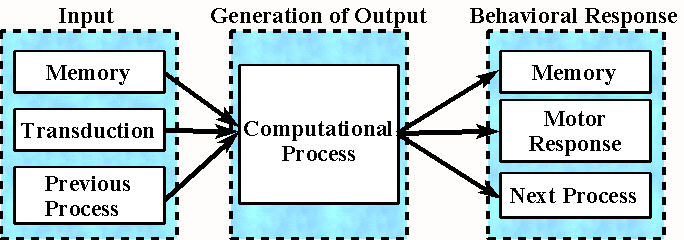
and those states. There are three conceptually distinct (though not
necessarily temporally distinct) stages. CTC/RTI framework portrays cognizers
as receiving input through sensory organs and/or memory and generating outputs
in the form of memories, inputs to other processes, and/or motor response
commands.
Cognitive scientists hotly debate the exact nature of the computational processes
involved in cognition. On the one hand, many theorists favor Turing-compatible
computation and its development in contemporary computer science and mathematics.
On the other hand, many theorists favor dynamically described state transitions
(ex. Connectionism). A similar theoretical dichotomy fosters
debate in the literature on representation. The two general theoretical
approaches towards a theory of representation are "
Nomic (law-like) Covariation" and "Functional Role Semantics". Neither theoretical
approach regarding the representation relation has gained general acceptance
as the theory presupposed by the RTI. However, there are several agreed-upon
constraints for a theory of representation.
First, the representation relation must be consistent with the physicalistic
nature of cognitive science.
Second, the relation must be present and explanatory in accepted explanations
within cognitive science. (an appropriate characterization of "accepted"
explanations is somewhat controversial). Philosophers particularly
would also like to see the accepted theory of representation explain many
of the widely accepted properties of belief. Block (1986) and Fodor
(1988) provide excellent discussions of the potential problems, the solutions
to which many Philosophers hope to find in a theory of mental representation.