Key Terms
Nomic or Nomological:
Law-like, particularly general physical or logical laws. It is the adjective form of nomology: the study and/or discovery of general physical and logical laws.
Information: Within the context of information theory, information just consists in the signals relayed by the standard sorts of communications devices, such as the telegraph, radio, or television, was well as the signals involved in electronic computers, servomechanism systems, and other data-processing devices. However, information theory has been applied usefully in a number of other fields, e.x. neuroscience. Since information is explicated in terms of signals, one might well ask what are signals and how they get their meanings? Signals can just be thought of as some principled exchange from point A to point B. Signals need not be meaningful in the ordinary sense of the term. Rather the information contained in a signal has to do with the elimination of possibilities at that source. A doorbell can be thought of as a signal. It can be thought of as carrying the information that someone is at the door. This still leaves many possibilities open, so not much information gets transmitted by our signal. After all, there still remains a huge set of possibilities as to the identity of that someone. Is it your Mom, your friend Bob, the police, a sales person? If you ask, "who's there?" They might yell back, "Bob". This too is a signal. It carries even more information, since it rules out lots of possibilities.
Information Theory: Information theory is a mathematical study of laws governing systems or networks that communicate or otherwise manipulate information. The goal of information theory has two general goals (1) articulate quantitative measures of information (i.e., how much information am I sending or receiving?) (2) create mathematically precise characterizations of the capacity of a given system or network to transmit, store, and/or process information. Information theory is the brain child of Claude E. Shannon. Shannon's paper, "The Mathematical Theory of Communication" in the Bell System Technical Journal (1948), essential gave birth the the topic.
Fred Dretske used information theory to define what is was for a mental state to represent something as follows:
A signal r carries the information that s is F = The conditional probability of s’s being F, given r (and k), is 1 (but, given k alone, less than 1)
The chief concern of information theory is to discover mathematical laws governing systems designed to communicate or manipulate information. It sets up quantitative measures of information and of the capacity of various systems to transmit, store, and otherwise process information.
Some of the problems treated are related to finding the best methods of using various available communication systems and the best methods for separating the wanted information, or signal, from the extraneous information, or noise. Another problem is the setting of upper bounds on what it is possible to achieve with a given information-carrying medium (often called an information channel). While the central results are chiefly of interest to communication engineers, some of the concepts have been adopted and found useful in such fields as psychology and linguistics. The boundaries of information theory are quite vague. The theory overlaps heavily with communication theory but is more oriented toward the fundamental limitations on the processing and communication of information and less oriented toward the detailed operation of the devices employed.
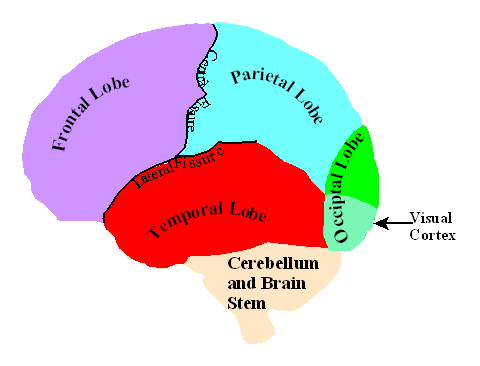
Stiate Cortex or Visual Cortex: The primary visual cortex is the part of the cortex that receives visual input from the retina. Hubel and Weisel showed that the primary visual cortex consists of cells responsive to simple and complex features of the visual world. Most cells in the visual cortex respond selectively (most strongly) to edges at some particular angle or the other (orientation preference). The cells also exhibit ocular dominance, that is they process information from one eye or the other. Cells and the properties to which they respond vary across the surface of the visual cortex gradually, and in complex patterns called orientation columns and ocular dominance columns.
Webvisions' Visual Cortex page
U of Sussex Page on the Visual Cortex
Idealization: In normal cases of scientific idealization theorists ignore certain negligible parameters in real systems to formulate a law. The resulting law, though not strictly true of any actual system, proves predictively adequate, and quantifies a real relation in actual physical systems.
Psychophysics: This term has traditionally stood for methods that quantified thresholds. But it is more generally used to signify the study of of the relationship in perception between stimulus properties and subjective experience.