Explanations in Cognitive Science
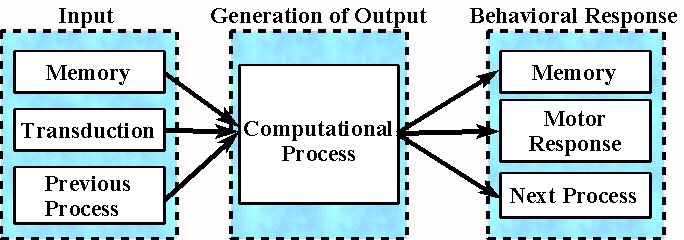
Two theses, the "Computational Theory of Cognition" (CTC) and the "Representational Theory of Intentionality" (RTI), form the foundation of Cognitive Science. The CTC holds that cognition is the computation of complex functions on representational states, where computation consists in performing operations defined over the syntactic structures (kinds) of representational states. The RTI asserts that mental states are about the world (have content) in virtue of a representation relation holding between the world and those states. CTC/RTI portrays cognizers as receiving input through sensory organs and/or memory and generating outputs in the form of memories, inputs to other processes, and/or motor response commands.
Figure 1: Conceptual Stages in Computation Explanations
Debate over the concept of computation relevant to the CTC centers around, on the one hand, Turing-compatible computation and its development in contemporary computer science and mathematics, and on the other hand dynamically described state transitions (ex. Connectionism). A similar dichotomy of theories occurs in the literature on representation. Neither theory regarding the representation relation presupposed by the RTI has gained general acceptance. However, there are several agreed-upon constraints for a theory of representation. First, the representation relation must be consistent with the physicalistic nature of Cognitive Science. Second, the relation must be present and explanatory in accepted explanations within Cognitive Science. (an appropriate characterization of "accepted" explanations is somewhat controversial).