Causal Theories of Mental Content
Introduction
Contemporary causal theories of mental content have predecessors dating
back to John Locke (Cummins 1989), Aristotle's De Anima, or even to Plato's
Theatetus. All such theories develop in the context of some or other
representational theory of mind (RTM). Contemporary causal theories
of mental representation have developed in the theoretical on context
of explanation in Cognitive Science. To better understand these theories
it is helpful to view their intended role as a explanatory primitive in
computation explanations in Cognitive Science.
Cognitive Science seeks to explain the cognitive capacities of humans,
animals, and possibly machines. However, the primary thrust of research
in Cognitive Science is directed towards explaining human cognitive abilities.
More recently theorists have devoted attention to consciousness and emotion.
The classic approach to explaining cognitive capacities within cognitive
science has two foundational theses; The "Computational Theory of Cognition"
(CTC) and the "Representational Theory of Intentionality" (RTI).
Together these theses dictate the explanatory structure off Cognitive Science.
The CTC characterizes cognition as the computation of complex functions
on representational states, where computation consists in performing operations
defined over the syntactic structures (kinds) of representational states.
The RTI asserts that mental states have intentionality (are about the world/have
content) in virtue of a representation relation holding between the world
and those states. There are three conceptually distinct (though not
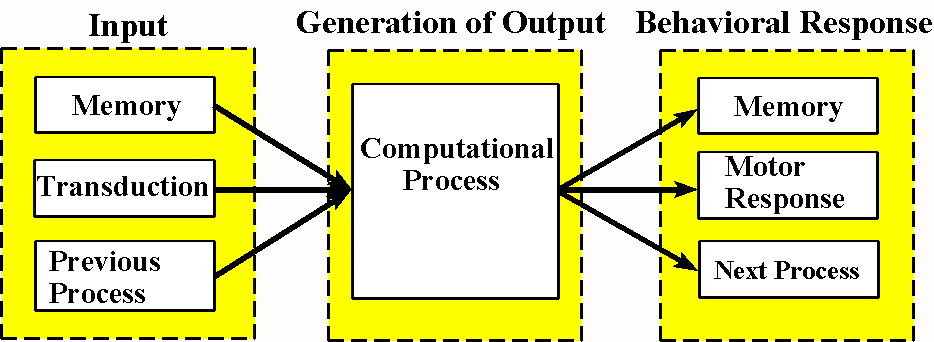
necessarily temporally distinct) stages. CTC/RTI portrays cognizers
as receiving input through sensory organs and/or memory and generating
outputs in the form of memories, inputs to other processes, and/or
motor response commands.
Cognitive Scientists hotly debate the exact nature of the computational
processes involved in cognition. On the one hand, many theorists
favor Turing-compatible computation and its development in contemporary
computer science and mathematics On the other hand, many theorists favor
dynamically described state transitions (ex. Connectionism).
A similar theoretical dichotomy fosters debate in the literature on representation.
The two general theoretical approaches towards a theory of representation
are "Nomic
(law-like)
Covariation" and "Functional Role Semantics". Neither theoretical
approach regarding the representation relation presupposed by the RTI has
gained general acceptance. However, there are several agreed-upon
constraints for a theory of representation. First,
the representation relation must be consistent with the physicalistic nature
of Cognitive Science. Second, the relation must
be present and explanatory in accepted explanations within Cognitive Science.
(an appropriate characterization of "accepted" explanations is somewhat
controversial). Philosophers particularly would also like to see
the accepted theory of representation explain many of the widely accepted
properties of belief. Block (1986) and Fodor (1988) provide excellent
discussions of the potential problems, the solutions to which many Philosophers
hope to find in a theory of mental representation.
Theories
One theoretic approach to articulating the representation relation,
Nomic Covariation, postulates a simple causal relationship between the
object or property and the state that represents the object or property.
The other approach, Functional Role Semantics, hypothesizes that a state
has content in virtue of the state's occupying a particular position in
a complex web of causal relationships characterizing the cognizer's functioning
(a theory of its psychology). Candidate content-fixing causal relationships
include causal relationships within the cognizer (i.e., relations between
brain states) and/or without (i.e., relations to the distal environment).
Both functional role and Nomic Covariation theories satisfy the (above)
first,
physicalistic constraint by hypothesizing that a cognizer's states represent
the distal environment solely as a result of the specific sorts of causal
connections had by those states. The theories diverge in terms of
the specific causal relationships each emphasizes.
Nomic Covariation
Nomic covariation theories hypothesize a causal connection between
an object or property in the world and the state that represents that object
or property within the cognizer. Information theory as well
as work within a sub-field of psychology called psychophysics inspire contemporary
Nomic Covariance theorists. Covariation theories, as a result, seem
to satisfy the second
constraint upon theories of representation, i.e., that the relation
must be present and explanatory in accepted explanations within Cognitive
Science. For example, Hubel and Wiesel (1977) investigate the representational
content of cells in the striate (visual) cortex by monitoring the activity
of those cells looking for nomic preferential relationships between the
activity of these cells and the presence of properties in the visual field.
A system's states represent those objects and/or properties of the distal
world with which they covary according to Nomic Covariation theories.
Specifically, Nomic covariation theories assign contents to states via
some version of the following definition (Cummins 1989, Fodor 1988):
State, Sb, represents B iff the system tokens
Sb when, only when, and because of B.
The intuitive appeal of Nomic Covariation stems from the idea that a
cognizer represents an object or property by being causally "in tune" with
that object or property. Further, Nomic Covariationists such as Jerold
Fodor advocate this approach because it assigns content to individual states,
Sb independent of how the cognizer operates upon those states (inferences
it can make) and/or the content of other states with which Sb might interact.
Fodor refers to this assignment of content as "Punctate Content, or "atomic
content." Among the advantages claimed by Fodor for punctate content
is that it allows for content identity across individuals who have quite
different theories regarding some object or property. Similarly,
punctate content provides the only theory whereby people can refer to real
objects even when they have great numbers of false beliefs about them.
For instance, Fodor claims (1992) that Aristotle thought about and talked
about the same things we refer to by "stars" even though he falsely believed
stars to be relatively close and rotating around the Earth on glassy spheres.
A final perceived advantage for Nomic Covariation approaches lies in that
they provide a clear-cut mechanism through which a cognizer can come to
know about an object or property in the world in virtue of its representational
capacities. A cognizer that represents an object or property in the
environment does so insofar as it can reliably detect its presence.
Problems for Nomic Covariation
Semantic Reduction
Within Philosophy particularly, but throughout Cognitive Science, theorists
raise three standard objections to Nomic Covariation theories. The first
objection challenges the ability of covariation theories to explain the
representational capacities of states with regard to objects/properties
beyond low-level perceptual properties (e.x. color), especially very abstract,
high-level objects and properties like justice or electron.
Nomic covariationists suppose that law-like covariation determines the
content of states representing properties ranging from low-level properties
like red or zero-crossing, to ordinary, medium sized objects
and properties like table or cow. States represent properties
and objects of a higher level of abstraction, like electron, in
virtue of their being defined in terms of the representational properties
of lower level states. (Fodor 1988)
Robert Cummins (1989) objects to this strategy, claiming that covariation
of states with objects/properties requires either implicitly or explicitly
represented heuristic information in the system. Thus, nomic covariation
will not explain the representational properties of any states but the
primitive representational states. All higher level concepts from dog
to democracy must get meaning through definition. At first glance,
it seems plausible to suppose that states that represent high-level theoretical
properties like electron get their meaning through definition in
terms of lower level properties. After all, such properties and objects
often have theoretical definitions. However, the failure of such semantic
reductions has shaped the history of Western Philosophy and Mathematics
(Quine 1952). Worse still, the lower the level of abstraction, the more
ordinary the concept, the less readily one accepts that one knows its meaning
because one has an explicit definition for it. For example, covariation’s
critics ask why, if the state one uses to represent crow gets its
meaning from being defined in terms of lower level properties, why do one
have difficulty in articulating that definition in any but the most superficial
sense? Psychological research also appears to run contrary to semantic
reductionism in that it indicates that object recognition and categorization
are strongly influenced by perceptual features, the exact make-up of which
is somewhat fluid.
According to Cummins, mental states achieve covariation with cats because
we already have explicitly represented or implicit knowledge about cats
(ex. they are domesticated felines). Further, the insight that covariation
is not the simple, unmediated causal relationship between the property/object
and the state, but rather the result of often complex causal interactions
within the system, suggests that Nomic Covariation is really just another
instance of its competitor, Functional Role Semantics.
The Disjunction Problem
The second, and most widely discussed problem for Nomic Covariation
theories is called the "Disjunction Problem". According to covariationists,
a state represents an object or property if the system tokens (enters into)
that state when confronted with the object or property and ONLY WHEN
confronted with that property. However, suppose that cognizer tokens a
state, Sc, in all of it’s cat interactions. According
to the WHEN clause of the covariationsist definition, the cognizer’s
state appears to represent cathood. Unfortunately, one night the cognizer
tokens an Sc when seeing a ferret in the darkness. The
ONLY
WHEN clause of the definition prima facie dictates that
Sc
never really represented cat. Rather, the cognizer has always represented
a property that we can only describe using the disjunction, "cat or ferret".
The disjunction problem poses difficulties for Nomic Covariation theories
in two ways: First, the theory seems to dictate counterintuitive representational
contents for states. If one has beliefs about cats, (e.x. cats are domesticated
felines that have a number of distinct breeds), then Nomic Covariation
seems to dictate that those beliefs have always been about things having
the property of being either a cat or a ferret. Second, the disjunction
problem seems to demonstrate that Nomic Covariation cannot account for
misrepresentation, since any seeming case of misrepresentation by a cognizer
becomes a correct representation of a disjunctive property under Nomic
Covariation. In other words, one never mistakenly believes that one sees
one’s mother at the corner, one always correctly believes that "mother/other"
is at the corner.
The disjunction problem poses difficulties for Nomic Covariation theories
in two ways: First, the theory seems to dictate counterintuitive representational
contents for states. If one has beliefs about cats, (e.x. cats are domesticated
felines that have a number of distinct breeds), then Nomic Covariation
seems to dictate that those beliefs have always been about things having
the property of being either a cat or a ferret. Second, the disjunction
problem seems to demonstrate that Nomic Covariation cannot account for
misrepresentation, since any seeming case of misrepresentation by a cognizer
becomes a correct representation of a disjunctive property under Nomic
Covariation. In other words, one never mistakenly believes that one sees
one’s mother at the corner, one always correctly believes that "mother/other"
is at the corner.
Theorists have explored a number of solutions to the disjunction problem.
All of these solutions rely upon some form of the idealization strategy:
A given solution will separate cases of the tokening (occurrence) of a
state into two groups, one in which content is already fixed and representational
error can occur (normal conditions), and the second class (ideal circumstances)
in which content is fixed by perfect covariation. There are several important
versions of this solution:
Ideal Conditions
Advocates of the ideal conditions solution to the disjunction problem
suggest one represents "mother" and not "mother/other" despite occasionally
mistaking others for mothers because under ideal perceptual conditions
(i.e., in good light, at close distance, etc.) one can distinguish mothers
from others. Difficulties arise for the ideal conditions solution when
one tries to specify what would count as ideal conditions for a given case
in a precise, and non-question-begging manner. For example, in the movie
"The Crying Game" an Irish man trying to escape from the IRA becomes romantically
involved with a woman. However, much to the surprise of the Irish man (and
the audience) this woman is actually a man. The reaction of the Irish man
clearly shows he misrepresented the gender of his romantic partner. Yet,
the Irish man did see his partner in good light, at close distance, etc..
The natural solution to this difficulty attempts to take advantage of the
idea that there are conditions under which such a sex difference would
not escape notice. However, in specifying such conditions as ideal conditions
for this case, one must be guided in a circular manner by one’s knowledge
of the property that the state actually represents.
Additionally, critics (Wallis 1994 and 1994a) also argue that appealing
to idealization to defeat the disjunction problem is strongly and negatively
disanalogous with successful uses of idealization is science.
Bibliography
-
Almog, J., Perry, J. and Wettstein, H., eds. Themes from Kaplan,
New York: Oxford University Press (1989).
-
Aristotle. De Anima, in The Complete Works of Aristotle: The
Revised Oxford Translation, Oxford: Oxford University Press (1984).
-
Ballard, D.H. "Cortical Connections and Parallel Processing: Structure
and Function," The Behavioral and Brain Sciences 9 (1986): 67-120.
-
Ballard, D.H and Hayes, P.J. "Parallel Logical Inference,"
Proceedings
of the Sixth Annual Conference of the Cognitive Science Society, Rochester,
NY. (1984).
-
Beaney, M., ed. The Frege Reader, Oxford: Blackwell Publishers (1997)
-
Berkeley, G. Principles of Human Knowledge, in M.R. Ayers, ed.,
Berkeley:
Philosophical Writings, London: Dent (1975).
-
Block, N. (ed.). Readings in Philosophy of Psychology, Vol. 2, Cambridge,
Mass.: Harvard University Press (1981).
-
Block, N. (ed.) Imagery, Cambridge, Mass.: The MIT Press (1982).
-
Block, N. "Mental Pictures and Cognitive Science,"
Philosophical Review
93 (1983): 499-542.
-
Block, N. "Advertisement for a Semantics for Psychology," in P.A. French,
T.E. Uehling and H.K. Wettstein, eds., MidwestStudies in Philosophy,
Vol. X, Minneapolis: University of Minnesota Press (1986): 615-678.
-
Block, N. "Mental Paint and Mental Latex," in E. Villanueva, ed.,
Philosophical
Issues, 7: Perception (1996): 19-49.
-
Boghossian, P.A. "Content," in J. Kim and E. Sosa, eds., A Companion
to Metaphysics, Oxford: Blackwell Publishers Ltd. (1995): 94-96.
-
Burge, T. "Individualism and the Mental," in P.A. French, T.E. Uehling
and H.K. Wettstein, eds., Midwest Studies in Philosophy, Vol. IV,
Minneapolis: University of Minnesota Press (1986): 73-121.
-
Chalmers, D. The Conscious Mind, New York: Oxford University Press
(1996).
-
Chalmers, D. "Connectionism and Compositionality: Why Fodor and Pylyshyn
Were Wrong," Philosophical Psychology 6 (1993): 305-319.
-
Chisholm, R. and Sellars, W. "The Chisholm-Sellars Correspondence on Intentionality,"
in H. Feigl, M. Scriven and G. Maxwell, eds.,
Minnesota Studies in the
Philosophy of Science, Vol. II, Minneapolis : University of Minnesota
Press (1958): 529-539.
-
Chomsky, N. Aspects of the Theory of Syntax, Cambridge, Mass.: The
MIT Press (1965).
-
Churchland, P.M. "Eliminative Materialism and the Propositional Attitudes,"
Journal
of Philosophy 78 (1981): 67-90.
-
Churchland, P.M. "On the Nature of Theories: A Neurocomputational Perspective,"
in W. Savage, ed., Scientific Theories: Minnesota Studies in the Philosophy
of Science, Vol. 14, Minneapolis: University of Minnesota Press (1989):
59-101.
-
Davidson, D. "Radical Interpretation," Dialectica 27 (1973): 313-328.
-
Davidson, D. "Belief and the Basis of Meaning," Synthese 27 (1974):
309-323.
-
Davidson, D. "Thought and Talk," in S. Guttenplan, ed., Mind and Language,
Oxford: Clarendon Press (1975): 7-23.
-
Davidson, D. "Rational Animals," Dialectica 4 (1982): 317-327.
-
Dennett, D. Content and Consciousness, London: Routledge and Kegan
Paul (1969).
-
Dennett, D. "The Nature of Images and the Introspective Trap," pages 132-141
of Dennett 1969, reprinted in Block 1981 (1981): 128-134.
-
Dennett, D. The Intentional Stance, Cambridge, Mass.: The MIT Press
(1987).
-
Dennett, D. "True Believers: The Intentional Strategy and Why it Works,"
in Dennett 1987 (1987a): 13-35.
-
Dennett, D. "Reflections: Real Patterns, Deeper Facts, and Empty Questions,"
in Dennett 1987 (1987b): 37-42.
-
Dennett, D. "Quining Qualia," in A.J. Marcel and E. Bisiach, eds.,
Consciousness
in Contemporary Science, Oxford: Clarendon Press (1988): 42-77.
-
Dennett, D. "Real Patterns," The Journal of Philosophy LXXXVII (1991):
27-51.
-
Devitt, M. Coming to Our Senses: A Naturalistic Program for Semantic
Localism, Cambridge: Cambridge University Press (1996).
-
Dretske, F. Seeing and Knowing, Chicago: The University of Chicago
Press (1969).
-
Dretske, F. Knowledge and the Flow of Information, Cambridge, Mass.:
The MIT Press (1981).
-
Dretske, F. Explaining Behavior: Reasons in a World of Causes, Cambridge,
Mass.: The MIT Press (1988).
-
Dretske, F. Naturalizing the Mind, Cambridge, Mass.: The MIT Press
(1994).
-
Evans, G. The Varieties of Reference, Oxford: Oxford University
Press (1982).
-
Field, H. "Mental representation," Erkenntnis 13 (1978): 9-61.
-
Flanagan, O. Consciousness Reconsidered, Cambridge, Mass.: The MIT
Press (1992).
-
Fodor, J.A. The Language of Thought, Cambridge, Mass.: Harvard University
Press (1975).
-
Fodor, J.A. "Propositional Attitudes," The Monist 61 (1978): 501-523.
-
Fodor, J.A. Representations, Cambridge, Mass.: The MIT Press (1981).
-
Fodor, J.A. "Introduction," in Fodor 1981 (1981a): 1-31.
-
Fodor, J.A. "Methodological Solipsism Considered as a Research Strategy
in Cognitive Psychology," in Fodor 1981 (1981b): 225-253.
-
Fodor, J.A. "The Present Status of the Innateness Controversy," in Fodor
1981 (1981c): 257-316.
-
Fodor, J.A. "Cognitive Science and the Twin-Earth Problem,"
Notre Dame
Journal of Formal Logic 23 (1982): 98-118.
-
Fodor, J.A. Psychosemantics, Cambridge, Mass.: The MIT Press (1987).
-
Fodor, J.A. A Theory of Content and Other Essays, Cambridge, Mass.:
The MIT Press (1990a).
-
Fodor, J.A. "Psychosemantics or: Where Do Truth Conditions Come From?"
in W.G. Lycan, ed., Mind and Cognition: A Reader, Oxford: Blackwell
Publishers (1990), (1990b): 312-337.
-
Fodor, J.A. The Elm and the Expert, Cambridge, Mass.: The MIT Press
(1994).
-
Fodor, J.A. and Pylyshyn, Z. "How Direct is Visual Perception?: Some Reflections
on Gibson’s ‘Ecological Approach’,"Cognition 9 (1981): 207-246.
-
Fodor, J.A. and Pylyshyn, Z. "Connectionism and Cognitive Architecture:
A Critical Analysis," Cognition 28 (1988): 3-71.
-
Frege, G. The Foundations of Arithmetic, trans. J.L. Austin, New
York: Philosophical Library (1953).
-
Frege, G. "On Sinn and Bedeutung" (1892) in Beany 1997: 151-171.
-
Frege, G. "Thought" (1918) in Beany 1997: 325-345.
-
Geach, P. Mental Acts: Their Content and Their Objects, London:
Routledge & Kegan Paul (1957) .
-
Goldman, A. "The Psychology of Folk Psychology," Behavioral and Brian
Sciences 16 (1993): 15-28.
-
Goodman, N. Languages of Art (2nd ed.), Indianapolis: Hackett (1976).
-
Grice, H.P. "Meaning," Philosophical Review, 66 (1957): 377-388;
reprinted in Studies in the Way of Words, Cambridge, Mass.: Harvard
University Press (1989): 213-223.
-
Harman, G. Thought, Princeton: Princeton University Press (1973).
-
Harman, G. "(Non-Solipsistic) Conceptual Role Semantics," in E. Lepore,
ed., New Directions in Semantics, London: Academic Press (1987):
55-81.
-
Harman, G. "The Intrinsic Quality of Experience," in J. Tomberlin, ed.,
Philosophical
Perspectives 4: Action Theory and Philosophy of Mind, Atascadero: Ridgeview
Publishing Company (1990): 31-52.
-
Haugeland, J. "Analog and analog," Philosophical Topics 12 (1981):
213-226.
-
Heil, J. "Being Indiscrete," in J. Greenwood, ed., The Future of Folk
Psychology, Cambridge: Cambridge University Press (1991): 120-134.
-
Horgan, T. and Tienson, J. Connectionism and the Philosophy of Psychology,
Cambridge, Mass: The MIT Press (1996).
-
Horst, S. Symbols, Computation, and Intentionality, Berkeley: University
of California Press (1996).
-
Hume, D. A Treatise of Human Nature, L.A. Selby-Bigge, ed., revised
P.H. Nidditch, Oxford: Oxford University Press (1978).
-
Jackendoff, R. Computation and Cognition, Cambridge, Mass.: The
MIT Press (1987).
-
Johnson-Laird, P.N. Mental Models, Cambridge, Mass.: Harvard University
Press (1983).
-
Johnson-Laird, P.N. and Wason, P.C. Thinking: Readings in Cognitive
Science, Cambridge University Press (1977).
-
Kaplan, D. "Demonstratives," in Almog, Perry and Wettstein 1989 (1989):
481-614.
-
Kosslyn, S.M. Image and Mind, Cambridge, Mass.: Harvard University
Press (1980).
-
Kosslyn, S.M. "The Medium and the Message in Mental Imagery," in Block
1982 (1982): 207-246.
-
Kosslyn, S. Ghosts in the Mind’s Machine, New York: W.W. Norton
& Co. (1983).
-
Kosslyn, S.M. and Pomerantz, J.R. "Imagery, Propositions, and the Form
of Internal Representations," Cognitive Psychology 9 (1977): 52-76.
-
Leeds, S. "Qualia, Awareness, Sellars," Noûs XXVII (1993):
303-329.
-
Lerdahl, F. and Jackendoff, R. A Generative Theory of Tonal Music,
Cambridge, Mass.: The MIT Press (1983).
-
Levine, J. "On Leaving Out What It’s Like," in M. Davies and G. Humphreys,
eds., Consciousness, Oxford: Blackwell Publishers (1993): 121-136.
-
Levine, J. "On What It Is Like to Grasp a Concept," in E. Villanueva, ed.,
Philosophical
Issues 6: Content, Atascadero: Ridgeview Publishing Company (1995):
38-43.
-
Lewis, D. "Analog and Digital," Noûs 5 (1971): 321-328.
-
Lewis, D. "Radical Interpretation," Synthese 23 (1974): 331-344.
(Reprinted, with Postscript, in Lewis 1983: 108-121.)
-
Lewis, D. Philosophical Papers, Vol. I, New York: Oxford University
Press (1983).
-
Loar, B. Mind and Meaning, Cambridge: Cambridge University Press
(1981).
-
Locke, J. An Essay Concerning Human Understanding, P.H. Nidditch,
ed., Oxford: Oxford University Press (1978).
-
MacDonald, C. and MacDonald, G. Connectionism: Debates on Psychological
Explanation, Oxford: Blackwell Publishers (1995).
-
Marr, D. Vision, New York: W.H. Freeman and Company (1982).
-
Martin, C.B. "Proto-Language," Australasian Journal of Philosophy
65 (1987): 277-289.
-
McCulloch, W.S. and Pitts, W. "A Logical Calculus of the Ideas Immanent
in Nervous Activity," Bulletin of Mathematical Biophysics 5 (1943):
115-33.
-
McGinn, C. "The Structure of Content," in A. Woodfield, ed.,
Thought
and Content, Oxford: Oxford University Press (1982): 207-258.
-
McGinn, C. Mental Content, Oxford: Blackwell Publishers (1989).
-
McGinn, C. "Content and Consciousness," in C. McGinn, The Problem of
Consciousness, Oxford: Blackwell Publishers (1992): 23-43.
-
Millikan, R. Language, Thought and other Biological Categories,
Cambridge, Mass.: The MIT Press (1984).
-
Newell, A. and Simon, H.A. Human Problem Solving, New York: Prentice-Hall
(1972).
-
Newell, A. and Simon, H.A. "Computer Science as Empirical Inquiry: Symbols
and Search," Communications of the Association for Computing Machinery
19 (1976): 113-126.
-
Osherson, D.N., Kosslyn, S.M. and Hollerbach, J.M. Visual Cognition
and Action: An Invitation to Cognitive Science, Vol. 2, Cambridge,
Mass.: The MIT Press (1990).
-
Papineau, D. Reality and Representation, Oxford: Blackwell Publishers
(1987).
-
Peacocke, C. Sense and Content, Oxford: Clarendon Press (1983).
-
Peacocke, C. "Perceptual Content," in Almog, Perry and Wettstein 1989 (1989):
297-329.
-
Peacocke, C. "Scenarios, Concepts and Perception," in T. Crane, ed., The
Contents of Experience, Cambridge: Cambridge University Press (1992):
105-35.
-
Pinker, S. Learnability and Cognition, Cambridge, Mass.: The MIT
Press (1989).
-
Port, R. and Van Gelder, T. Mind as Motion: Explorations in the Dynamics
of Cognition, Cambridge, Mass.: The MIT Press (1995).
-
Putnam, H. "The Meaning of ‘Meaning’," in
Philosophical Papers, Vol.
2, Cambridge: Cambridge University Press (1975): 215-71.
-
Pylyshyn, Z. "The Rate of ‘Mental Rotation’ of Images: A Test of a Holistic
Analogue Hypothesis," Memory and Cognition, 7 (1979): 19-28.
-
Pylyshyn, Z. "Imagery and Artificial Intelligence," in Block 1981 (1981a):
170-194.
-
Pylyshyn, Z. "The Imagery Debate: Analog Media versus Tacit Knowledge,"Psychological
Review 88 (1981b): 16-45.
-
Pylyshyn, Z. Computation and Cognition, Cambridge, Mass.: The MIT
Press (1984).
-
Raffman, D. "The Persistence of Phenomenology," in T. Metzinger, ed., Conscious
Experience, Paderborn: Schöningh/Imprint Academic (1995): 293-308.
-
Ramsey, W., Stich, S. and Garon, J. "Connectionism, Eliminativism and the
Future of Folk Psychology," Philosophical Perspectives 4 (1990):
499-533.
-
Rey, G. "Introduction: What Are Mental Images?" in Block(1981): 117-127.
-
Rey, G. "Sensations in a Language of Thought," in E. Villaneuva, ed., Philosophical
Issues 1: Consciousness, Atascadero: Ridgeview Publishing Company (1991):
73-112.
-
Rumelhart, D.E. "The Architecture of the Mind: A Connectionist Approach,"
in M.I. Posner, ed., Foundations of Cognitive Science, Cambridge,
Mass.: The MIT Press (1989): 133-159.
-
Rumelhart, D.E. and McCelland, J.L. Parallel Distributed Processing,
Vol. I, Cambridge, Mass.: The MIT Press (1986).
-
Schiffer, S. 1987. Remnants of Meaning, Cambridge, Mass.: The MIT
Press (1987).
-
Schiffer, S. "Introduction to the Paperback Edition," in
Meaning,
Oxford: Clarendon Press (1988): xi-xxix.
-
Searle, J.R. Intentionality, Cambridge: Cambridge University Press
(1983).
-
Searle, J.R. The Rediscovery of the Mind, Cambridge, Mass.: The
MIT Press (1990).
-
Sellars, W. "Empiricism and the Philosophy of Mind," in K. Gunderson, ed.,
Minnesota
Studies in the Philosophy of Science, Vol. I, Minneapolis: University
of Minnesota Press (1956): 253-329.
-
Shepard, R.N. and Cooper, L. Mental Images and their Transformations,
Cambridge, Mass.: The MIT Press (1982).
-
Shoemaker, S. "Qualities and Qualia: What’s in the Mind?"
Philosophy
and Phenomenological Research 50 (1990): 109-31.
-
Smolensky, P. "On the Proper Treatment of Connectionism,"
Behavioral
and Brain Sciences, 11 (1988): 1-74.
-
Smolensky, P. "Connectionist Modeling: Neural Computation/Mental Connections,"
in L. Nadel, L.A. Cooper, P. Culicover and R.M. Harnish, eds., Neural
Connections, Mental Computation: The MIT Press (1989): 49-67.
-
Smolensky, P. "Connectionism and the Language of Thought," in B. Loewer
and G. Rey, eds., Meaning in Mind: Fodor and His Critics, Oxford:
Basil Blackwell Ltd (1991): 201-227.
-
Sterelny, K. "Fodor’s Nativism," Philosophical Studies55 (1989):
119-141.
-
Stich, S. 1978. "Autonomous Psychology and the Belief-Desire Thesis," The
Monist 61 (1978): 573-591.
-
Stich, S. From Folk Psychology to Cognitive Science, Cambridge,
Mass.: The MIT Press (1983).
-
Strawson, G. Mental Reality, Cambridge, Mass.: The MIT Press (1994).
-
Tye, M. The Imagery Debate, Cambridge, Mass.: The MIT Press (1991).
-
Tye, M. Ten Problems of Consciousness, Cambridge, Mass.: The MIT
Press (1995).
-
Tye, M. Consciousness, Color, and Content, Cambridge, Mass.: The
MIT Press (2000).
-
Van Gelder, T. "What Might Cognition Be, if not Computation?",
Journal
of Philosophy XCI (1995): 345-381.
-
Von Eckardt, B. 1993. What Is Cognitive Science?, Cambridge, Mass.:
The MIT Press (1993).
-
Von Eckardt, B. "Connectionism and the Propositional Attitudes," in C.
Emeling and D.M. Johnson, eds., The Mind as a Scientific Object: Between
Brain and Culture (forthcoming).
-
Wittgenstein, L. Philosophical Investigations, trans. G.E.M. Anscombe,
Oxford: Blackwell Publishers (1953).
Other Internet Resources
cognitive
science | computing,
modern history of | connectionism
| consciousness: and intentionality | consciousness:
representational theories of | folk
psychology: as a theory | folk
psychology: as mental simulation | information | language
of thought hypothesis | mental content | mental content: externalist
theories of | mental content: narrow | mental content:
nonconceptual | mental content: teleological theories of | mental
imagery | mental
representation | neuroscience,
philosophy of | perception | qualia
| reference