Map showing Miletus from
http://commons.wikimedia.org/wiki/File:Miletus_Bay_silting_evolution_map-en.svg
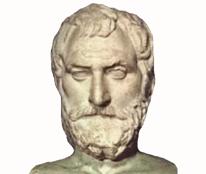
Bust of Thales
(624-546BCE) from http://www.daviddarling.info/encyclopedia/T/Thales.html
Philosophy’s
Movement Toward Cognitive Science
Early
Beginings of Science and Philosophy
Early philosophy tends not to
distinguish strongly between different areas of inquiry.
For the most part the earliest Greek philosophers, for example, Thales of
Miletus (624-546 BCE), speculate as to the most basic elements of the world, and
how these elements result in all other objects, properties, and events.
Thales supposes that water is the most basic element, and all other objects,
properties, and events result from changes to water.
Scholars commonly identify Thales as the first philosopher in the western
tradition, and Miletus, a city on the coast of present-day Turkey, as western
philosophy’s point of origin. Thales
reportedly predicted a solar eclipse in 585BCE, and it is Thales' combination of
empirical astronomy and theoretical speculation that lead many to identify
Thales as the marking the beginning of western science as well. Thales and
many of the early Greek philosophers were physicalists or materialists, holding
that all that exists is matter and the void. However, many Greeks believed
in immortal souls. With the decline of Greek and Roman civilization,
religious approaches to understanding the universe eclipsed the ancient
materialism of the Greeks.
|
|
|
|
Map showing Miletus from
http://commons.wikimedia.org/wiki/File:Miletus_Bay_silting_evolution_map-en.svg |
Bust of Thales
(624-546BCE) from http://www.daviddarling.info/encyclopedia/T/Thales.html |
Most
of what we know about the early Greek philosophers comes from fragments of their
writings and reports of their views in the works of later writers.
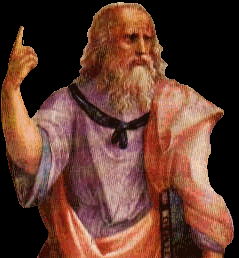
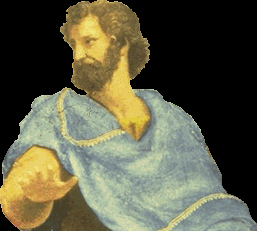
However, by about 400 BC philosophers like Plato
(427-347BCE) and Aristotle (400-320BCE) have
begun to write works covering more or less specific areas of inquiry, and spent
significant time considering investigative methodology. Both of these
thinkers contributed to the two general areas of inquiry that converge (for
some) upon the explanatory schema of cognitive science: Epistemology
(The Sub-discipline Exploring the Nature, Sources, & Limits of Knowledge)
& Philosophy of Mind (The Sub-discipline
Exploring the Nature of the Mind). Additionally,
the ancient Greek philosophers considered what we know as the the sciences and
mathematics to be part of philosophy.
Plato wrote the Meno
1
and later the Theatetus
2
, both of which prove to be influential works in epistemology.
But, epistemological ruminations date back to the presocratics and
continue today.
Likewise, in The
Republic
3
, Plato introduces the tripartite division of the soul,
which has strongly influenced conceptions of the mind and its operations.
According to that work the soul has three parts; the appetitive
soul, the spirit or passionate soul, & the thinking or rational soul.
Each element of the soul has its own characteristic desires.
The good for humans consists in the subjugation of the appetitive soul to
the passionate soul, which is in turn subjugated to the rational soul. Thus,
reason, emotion, and appetite become separate in Plato.
One might argue that this represents the first attempt to understand the
mind in terms of constitutive elements of the mind, the functions they perform,
and the relationships that emerge. In De
Anima
4
, Aristotle considers not only human mentality, but nature of the souls
of all living creatures. Aristotle's notion of a soul involves
aspects of a life-force and of mentality. Souls are essences that combine
with matter to create the specific sort of creature with specific sorts of
properties and capacities. Aristotle believes that plants possess the
ability to gain nourishment and reproduce themselves; animal souls have the
additional capacities of sense perception and ambulation. Only human souls
have the capacity for intelligence, and only the intelligent aspects of the soul
are immortal for Aristotle. De Anima includes discussions on
methodology, the senses, and thought and reasoning.
|
|
|
|
Plato
(427-347BCE) |
Aristotle
(400-320BCE) |
Euclid's
Geometry
One
of the most under appreciated figures in shaping the western notions of
mathematics, philosophy, science, rationality and mentality is Euclid of
Alexandria (325BCE-265BCE). Euclid is a Greek mathematician, who likely
received his training in geometry in Athens from students of Plato before moving
to Alexandria. Euclid's best-known work, The
Elements
5
(approximately 300BCE),
systematically and rigorously organizes geometrical knowledge in terms of
indubitable axioms from which all other truths are deduced by careful proof.
The Elements also includes a treatment of basic number theory. The
Elements provides readers with a comprehensive collection geometrical
theorems and proofs developed by such earlier mathematicians as Thales,
Pythagoras, Plato, Eudoxus, Aristotle, and Menaechmus.
Euclid's accomplishment in The Elements was not its content, per
se, but the organization and rigor of its presentation. Indeed, academics
use Euclid's book as a text as late as the beginning of the 20th century.
Euclid's rigorous axiomatization creates a model for mathematics, philosophy,
and science that remains influential today, and which often serves as a model
for rational thought. Euclid's geometry proves so influential that it
influences great thinkers holding very different theories about the nature of
the mind. For instance, Thomas Hobbes (1588–1679) is a hard-bitten
physicalist. Hobbes views all things, including politics and the mind, in
terms of mechanistic operations upon physical matter. Hobbes speculates in
his Elements
of Philosophy
6
that
“By ratiocination [reasoning], I mean computation,” (p. 7) which Hobbes'
views as analogous to simple arithmetical operations upon words, where words
come to signify the objects of our experiences stored memory.
As we will see below, René Descartes (1596–1650) models both his
epistemology and his scientific method on Euclid, in his books Discourse
on the Method for Conducting One's Reason Well and for Seeking Truth in the
Sciences
7
and Mediations
on First Philosophy
8
though he famously holds
that the mind is immaterial. Benedictus
De Spinoza (1632–1677)
writes his famous, posthumously published work Ethics
9
in an axiomatic format.
In the Ethics Spinoza argues that the universe consists of one infinite,
necessary, and deterministic substance that he seems to equate with both God and
nature, with both mind and body.
All
these thinkers portray one’s knowledge--and rationale belief corpus--as having
(or ought to have) an organizational structure and genesis like the Euclidian
geometry of The Elements. One’s
knowledge all flows from careful arguments based upon premises (axioms), the
truth of which one cannot doubt. Deductive
reasoning transmits the certainty and truth of one’s initial principles to all
other beliefs. Thus, the impact of Euclid consists in providing a paradigmatic
instance of intellectual accomplishment, which can and does serve as an
extremely influential conception of reason itself--and often all mentality--as
consisting in deductive operations on statements tracing back to a set of
statements held to be certain and indubitable; that is, in terms of logical
operations on truth-functional representations (i.e., representations that can
be true or false). One cannot
underestimate the impact of this conception of reason and mentality upon our
theoretical musings upon rational inquiry, reason, and the mind.
|
|
Euclid’s Axioms 1.) To draw a straight
line from any point to any other. 2.) To produce a finite
straight line continuously in a straight line. 3.) To describe a circle
with any centre and distance. 4.) That all right angles
are equal to each other. 5.) That, if a straight
line falling on two straight lines make the interior angles on the same
side less than two right angles, if produced indefinitely, meet on that
side on which are the angles less than the two right angles. |
|
|
Euclid of Alexandria
(325BCE-265BCE) |
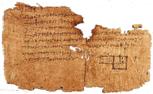
One of the oldest
surviving fragments of Euclid's Elements, found at Oxyrhynchus
and dated to circa AD 100. The diagram accompanies Book II, Proposition 5.
From Wikipedia http://en.wikipedia.org/wiki/Euclid |
|
|
|
|
|
|
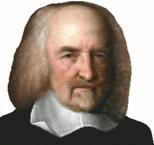
Thomas Hobbes
(1588–1679) |
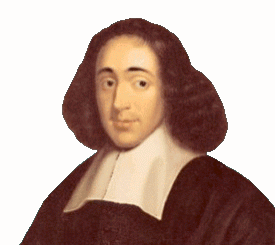
Baruch
de Spinoza (1632–1677) |
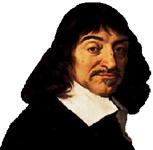
Rene
Descartes (1596-1650) |
Descartes
and Dualism
Scholars
generally hold that the European Renaissance began in the Italian city state of
Florence in Tuscany in the 14th century. The
increase in commerce, artistic, and religious activity associated with the
period from the 14th to the 17th century also brought increased scientific
activity that eventually lead to what historians call the scientific revolution.
Writers often associate the beginning of the scientific revolution with
the publication of two important works: Nicolaus Copernicus' (1474-1543) death
in 1543 marks the publication (in Germany) of his privately circulated
manuscript called Commentariolus (Little Commentary) under the title
De revolutionibus orbium coelestium
10
(On the Revolutions
of the Heavenly Spheres, published in 1543 at Nuremberg, Germany).
The physician, Andreas Vesalius (1514-1564), publishes his seven volume
text on anatomy called De Humani Corporis Fabrica
11
(On the Fabric of the
Human body, published in 1555). Both
of these works challenge the traditional theories and figures in their areas.
Copernicus forwards the heliocentric conception the the universe in
contrast to Ptolemy. Vesalius
challenges many aspects of the anatomical teachings of Galen.
These works and many others served to create a tradition of deterministic
mechanism in science. This tradition
increasingly sought to understand all phenomena in terms of universal physical
laws discovered through controlled empirical experimentation, even life and the
mind. The French philosopher,
physicist, mathematician, anatomist René Descartes (1596-1650) painted the
tension between the spiritual or immaterial world view and the mechanistic
physical world view in stark contrast in his works, particularly his highly
influential work Meditations on First
Philosophy (1641).
Like
all thinkers of the time, Descartes is dualist as well as a scientist,
mathematician, and philosopher--though those endeavors are not particularly
distinct at the time. He came to
science rather indirectly: Descartes
attends a Jesuit school located at La Flèche, France called Collège Royal
Henry-Le-Grand in 1607. His
graduation from Henry-Le-Grand sees him earn his degree and license in Law at
the University of Poitiers in 1616. Descartes
joins the army of the Dutch Republic for a brief time in 1618, during which time
he meets Isaac Beeckman, who reignites his interest in physics and mathematics.
Descartes claims to have had dreams shortly thereafter which he
interprets as a divine sign that he should found a unified science of nature
based upon mathematics.
Descartes'
work, Meditations on First Philosophy
(1641), proves important for two reasons: (1) Because as a scientist and
mathematician, he brings the goal rigorous scientific methodology and
explanation to philosophical speculation regarding the mind.
For instance, Descartes defines the properties of mental and physical
substance, thereby further articulating the sorts of properties and causal
connections that ought to underlie any explanation of the mental.
Descartes defines two substances, one mental and one physical.
However, unlike thinkers before him, Descartes attributes wholly
different contradictory properties to these different substances.
Descartes characterizes mental substance as a non-extended thinking
substance that manifests mental properties like consciousness and belief.
In contrast, physical substance is essentially extended, having
properties of shape, size, position, and number.
(2) Because of his dualist conception of the mind, and because of his
scientific slant on philosophy, the Meditations--as well as his Les
Passions De L'ame
12
(Passions of the Soul,
published in 1649) and Traite de l'homme
13
(Treatise on Man,
published 1664, written 1637), lay the groundwork for a switch in emphasis in
the philosophy of mind. Whereas
philosophic speculation regarding the mind has had a strong epistemic and
functional emphasis before Descartes, emphasis turns somewhat away from
epistemology and towards ontology. That
is, philosophers become increasing interested in understanding if/how the mind
could be physical in nature and explained through science.
This interest continues today, and has led to the explicit formulation of
a variety of theories regarding the nature of the mind and its relationship to
the physical world. Though Descartes
is a dualist, he actually furthers the mechanistic picture in that he views the
body as an elaborate machine. He
takes pride in his claims to have furthered mechanistic explanation of human and
animal behaviors.
Ironically, it is the emphasis on science and physicalism that inspires the climatic works on the mind with a strong epistemic stance. John Locke (1632-1704) writes my An Essay Concerning Human Understanding 14 (1690) to flush out the corpuscularian philosophy (essentially the hypothesis that the physical world is composed of atoms and “the void” which he learns from the great chemist Robert Boyle) with regard to the mind. Like all British Empiricists, Locke seeks to understand the mind in order to more accurately understand and theorize about the nature, limits, and sources of knowledge. David Hume (1711-1776), shares Locke’s project of understanding the nature of the mind in order to understand the nature, sources, and limits of knowledge. However, reflection upon observations--as opposed to a particular ontological picture--drive Hume's theorizing in works like, A Treatise of Human Nature 15 (1739-40) and An Enquiry concerning Human Understanding 16 (1748). I come to the conclusion that empiricist theories of mind undermine one’s claim to knowledge of physical objects and causality.We both outline theories of mind that have representations and operations on those representations. Unlike Hobbes--but like Descartes--Locke's and Hume's model for representations are pictures. Locke and Hume view the mental processes underlying thought and reasoning as resulting from operations on ideas. Of particular significance, Hume views human reasoning about the experiences as resulting from operations of association rather than by deduction. For example, Hume thought that cause and effect reasoning results from habitual associations between ideas because of their constant conjunction in experience. In the An Abstract of a Book lately Published: Entitled A Treatise of Human Nature etc. 17 (1740) tells readers that,
| Tis evident that all reasonings concerning matter of fact are founded on the relation of cause and effect, and that we can never infer the existence of one object from another, unless they be connected together, either mediately or immediately... Here is a billiard ball lying on the table, and another ball moving toward it with rapidity. They strike; and the ball which was formerly at rest now acquires a motion. This is as perfect an instance of the relation of cause and effect as any which we know, either by sensation or reflection. (¶8-9) |
The
third famous British Empiricist George Berkeley (1685-1753), differs from Locke
and Hume in that his work emphasizes ontological issues.
Indeed, in his works, A Treatise Concerning the Principles of Human Knowledge, Part I
18
(1710) and Three
Dialogues Between Hylas and Philonous
18
(1713), Berkeley argues
against materialism in favor of a view called Idealism, in which nothing exists
but minds and their ideas.
Thus,
with Berkeley we see the three major classes of theories regarding the
ontological nature of the mind and body. First,
materialism (or reductive materialism) holds that there is only one type of
substance, material substance. The
mind and all mental properties result from modifications of the same substance
as all other things, i.e., the mind = the body.
Second, dualism (or substance dualism) holds that there are two distinct
kinds of substance, mental substance and physical substance.
The mind is a mental substance, while the body is a physical substance.
Finally, idealism holds that there is only one kind of substance, mental
substance, and all physical objects and properties are actually ideas and their
properties. As well see soon, these
basic positions have many permutations.
Interestingly,
Thomas Reid (1710-1796) rigorously rejected the notion of a representational
mind at about the same time that people were reading Hume and Locke.
Another sort of objection, this time to the idea of a scientific
psychology comes from Immanuel Kant (1724-1804).
Kant, a physicist and philosopher, adopts the same general project of
understanding the nature of the mind in order to further epistemological
theorizing as Hume.. However, in his
book, The Critique of Pure Reason
19
(Kemp Smith's English
translation 1929), Kant wants to counter Hume’s skeptical conclusions.
Kant argues that much of our knowledge flows from the innate
presuppositions necessary for experience itself.
Interestingly, though Kant develops and draws heavily upon a theory of
the mind in his work, he argues that a science of the mind is impossible because
the field cannot be mathematicized.
The
Twentieth Century
Substance
Dualism
Despite
Kant's skepticism, scientific psychology does begin to develop.
By 20th century concerns over how best to understand and explain the
mind’s physical origins drives philosophical speculation regarding the mind,
supplanting the emphasis on epistemology. Additionally,
concerns arising from philosophical interests in language and mathematics begin
to pervade the philosophy of mind. Particularly
in the second half of the twentieth century, philosophers expand upon the basic
theories of mind just discussed. It
is, therefore, convient to use this section to outline the standard positions in
the philosophy of mind, including those that developed during this period. As
noted above, each view--reductive materialism, dualism, and idealism constitute
categories of theoretical positions in which permutations exist.
For instance, in the case of dualism philosophers commonly note three
distinct positions: Descartes, held
the most common position--interactive dualism.
Interactive dualism holds that mental substance and physical substance
causally interact with one another. Interactive
dualism might seem like the only possibility.
However, two other possibilities emerge if one denies that mental and
physical substances interact. Such a
denial might seem ridiculous given the apparent connection between mental
phenomena and physical phenomena. For
instance, if someone steps on your foot, a physical phenomenon, you will likely
experience a feeling of discomfort in your foot, a mental phenomenon.
However, Descartes' clarity and rigor in differentiating mental and
physical substance, ironically, raises a significant challenge to
interactionism.
Recall
that mental substance is essential non-spatial, lacking all physical properties.
Likewise, physical substance is essentially spatial, lacking all mental
properties. If the mind and the body
are fundamentally different sorts of stuff, one must ask, "How could these
two substances possibly causal interact with one another?"
For that matter, given that the mind is non-spatial, where could they
possibly causally interact? It seems
indubitable that the mind and the body interact with one another, and so
interactive dualism must explain how such causal interaction could possibly
occur. Philosophers have articulated
many difficulties with interactive dualism, but most agree that the difficulties
with causal interaction have to rank very high.
In addition to difficulties with the very idea of inter-substance
causation, another serious difficulty emerges almost immediately from dualistic
interactionism. In a mechanistic,
deterministic physical science, all changes in the physical world should be
explicable (at least in principle) by universally applicable purely mechanistic,
deterministic physical laws. But, if
mental substances and causal substances causally interact, mental causation
renders universal purely mechanistic, deterministic physical laws impossible.
Mental to physical causation will always fall outside purely physical
laws.
One
possible solution to this last worry involves denying interactionism--at least
in one direction. Epiphenomenalism
is the view that changes in physical substances can causal mental phenomena, but
that changes in mental substances cannot cause changes in physical substances or
their properties. Thus, one can
still hold that some causal connections exist between the mental and the
physical, but mental causation will never violate universally applicable purely
mechanistic, deterministic physical laws. While
epiphenomenalism might allow for deterministic physical laws, it implies that
mental phenomena never cause physical phenomena--violating the seeming obvious
nature of mind-body interactions. Worse
still, epiphenomenalism must explain why causation only runs from the physical
to the mental, and not vice versa.
The
second dualist solution to the problem of interaction also denies interactions.
Parallelism is the view that mental and physical substances only appear
to causally interact. Instead of
causal interaction, mental and physical changes merely mirror one another,
creating the illusion of interaction. One
might find one anti-interactionism less plausible than the next.
However, considering the difference between causation and correlation
might make parallelism seem somewhat more plausible.
The time on my watch may always correlate with the time on your watch,
but no one supposes that our watches causally interact.
One
can summarize the various substance dualistic positions in the following table:
table
Logical Behaviorism
The first answer to these sorts of questions was simply that mental properties were just physical properties. Such views are expressed by, for example, Aristotle 4 when he claims that,
|
...their
definitions ought to correspond, e.g. anger should be defined as a
certain mode of movement of such and such a body (or part or faculty of
a body) by this or that cause and for this or that end. (Book I,
Part I, ¶6) |
However, most historical accounts trace type-type indentity theory to two papers "Is Consciousness a Brain Process?" 20 by U.T. Place (1956) and "The 'Mental' and the 'Physical'" 21 by Herbert Feigl (1958). The first attempt to systematically address the difficulties for physicalism is a position called Logical or Analytical Behaviorism. In general, most historians cite Gilbert Ryle's book, The Concept of Mind 22 (1949), then Hempel's "The Logical Analysis of Psychology" 23 (1935,1949). However, Hempel's article was published, though in French, over 14 years earlier. Both works are important because they share a common shift of emphasis that has continued to shape thinking about the mind in philosophy. Both Ryle and Hempel seek to defuse the seeming difficulties in understanding how mental properties arise from or are identical to physical properties by arguing that the meanings of mental terms are exhausted by behavioral terms. Hempel tell readers, 23
|
All
psychological statements which are meaningful, that is to say, which are
in principle verifiable, are translatable into statements that do not
involve psychological concepts, but only the concepts of physics.
The statements of psychology are consequently physicalistic statements.
(p.18) |
Similarly, Ryle asserts, 22
|
In this chapter I try to show that when we describe people as exercising qualities of mind, we are not referring to occult episodes of which their overt acts and utterances are effects; we are referring to those overt acts and utterances themselves. (p.25) |
Pics
While
Hempel aims primarily to address scientific and ontological issues, Ryle sees
his work in a different light. Instead,
Ryle tries to provide an analysis of the concepts of ordinary language.
In both cases, however, the seeming difficulties associated with the
equation of mental properties and physical properties are traced to an improper
understanding of the true meanings of mental terms.
Ryle asserts that
22
,
This
book offers what may with reservations be described as theory of mind.
But it does not give new information about minds.
We possess already a wealth of information about minds, information which
is neither derived from, nor upset by, the arguments of philosophers.
The philosophical arguments which constitute this book are intended not
to increase what we know about minds, but to rectify the logical geography of
the knowledge which we already possess. (p.7)
Additonally,
Ryle's emphasis on intelligent behavior marks a differentiation between mental
properties that has come to be standard in the philosophy of mind, and which
allows for the initial explanatory focus of cognitive science on cognition.
Specifically, philosophers differentiate between mental properties and
states that are strongly (or even definitively) phenomenal in nature, called
qualia or qualitative mental states, and mental properties or states that are
primarily (or even definitively) intentional, called intentional states or
propositional attitudes. Examples of
the former (qualia) include pains, itches, seeing red, anger etc..
Examples of the latter (intentional states) include beliefs and desires.
Intentional states may have some phenomenal aspects, but they are
importantantly representational--those states are about objects, properties,
and/or events in the world.
Logical
behaviorists like Hempel seek to build upon real progress by experimentalist
like Pavlov, Watson, Tolman, and Skinner as well as by scientists across a wide
sawth of the sciences. They view the
explosion of scientific progress from the beginnings of the scientific
revolution to the middle twentieth century as deriving primarily from tying
theories and theoretical terms to rigorous empirical measurement and
experimentation. However, logical
behaviorism faces three significant difficulties.
First, the meanings of many mental terms seem essentially tied to
qualitative subjective experience as opposed to the behaviors they cause.
Thus, many people find the awfulness of pain essential to being in pain,
but few find verbal demonstrations essential to being in pain.
A person paralized by curare will not exhibit the normal behavioral
effects of pain when stabbed in the arm. However,
it seems impropable to suppose that such a person feels no pain.
Likewise, actors really do suffer for their art according to logical
behaviorists. Second, many mental
properties such as aibohphobia (a fear of palindromes), ankylophobia (fear of
stiff or immobile joints) and malaise (a vague feeling of discomfort, one cannot
precisely identify, but which is often desdcribed as a sense that things are
"just not right.") seem not to have any definitive set of behvorial
effects. Third, mental terms do not
operate, for the most part, in isolation from one another.
Rather, the connections between the typical behavioral causes and typical
behavioral effects--even for those mental terms that appear to have more or less
criterial behavioral causes and effects--are mediated by the interactions mental
states with other mental states. For
instance, the causes and effects of your belief that this text is remarkably dry
cannot be determined in isolation. If
you love dry and boring texts, you may read all night.
If you are hungry, your belief may result in your getting a chocolate
bar.
Theorists
are exploring the general difficulties facing approaches like Ryle's and
Hemple's in the technical literature even before Ryle publishes The Concept of
Mind. However, Putnam's
"Psychological Concepts, Explication, and Ordinary Language"
24
(1957) and Chisholms "Intentionality and the Theory of Signs"
25
(1952) served to make explicit and popularize the implications of these
technical problems for logical behaviorism.
Type-Type Reductionism
As
noted above, historians generally credit the British philosopher and
psychologist U.T. Place (1924-2000) and the Austrian philosopher Herbert Feigl
(1902-1988) as the source of the modern identity version of physicalism.
Place's colleague, J.J.C. Smart (1920-
) also adopts this position. The
identity theorists' motivations stem in large part from (and build upon)\ the
difficulties with logical behaviorism. For
instance, Place tells readers,
20
The
view that there exists a separate class of events, mental events, which cannot
be described in terms of the concepts employed by the physical sciences no
longer, commands the universal and unquestioning acceptance amongst philosophers
and psychologists which it once did. Modern physicalism, however, unlike the
materialism of the seventeenth and eighteenth centuries, is behaviouristic.
Consciousness on this view is either a special type of behaviour, 'sampling' or
'running-back-and-forth' behaviour as Tolman (1932,p. 206) has it, or a
disposition to behave in a certain way, an itch for example being a temporary
propensity to scratch. In the case of cognitive concepts like 'knowing',
'believing', 'understanding', 'remembering' and volitional concepts like
'wanting' and 'intending', there can be little doubt, I think, that an analysis
in terms of dispositions to behave (Wittgenstein, 1953; Ryle, 1949) is
fundamentally sound. On the other hand, there would seem to be an intractable
residue of concepts clustering around the notions of consciousness, experience,
sensation and mental imagery, where some sort of inner process story is
unavoidable (Place, 1954). It is possible, of course, that a satisfactory
behaviouristic account of this conceptual residuum will ultimately be found. For
our present purposes, however, I shall assume that this cannot be done and that
statements about pains and twinges, about how things look, sound and feel, about
things dreamed of or pictured in the mind's eye, are statements referring to
events and processes which are in some sense private or internal to the
individual of whom they are predicated. (p.44)
Two
central ideas define type-type identity: First, Place and Feigl hold that
behavioristic and identity analyses of mental terms do not exhaust the meaning
of mental terms in ordinary language. That
is, the new definitions of mental terms are not analytic--they do not capture
the individually necessary and jointly sufficient conditions thought to dictate
the meanings of ordinary terms. Place
and Feigl hold that mental and physical terms pick out classes or kinds of
things in virtue of their meanings, and that a significant part of the meaning
of ordinary mental terms (as well as of the identity theorists new analyses of
those terms) is synthetic--i.e., going beyond the definitional meaning, usually
as a result of experience. Specifically,
they hold that the various behavioral associations between mental terms and
physical/bodily terms serve to provide an initial description of a physical
(brain) state. One can modify the
intial behavioral descriptions, to the entent necessary, as a result of
experience. Such descriptions
ultimately determine the physical state that corresponds to the mental state.
The identification of the physical state with the mental state
constitutes a synthetic discovery.
Pics
In
1970, Donald Davidson (1917-2003) proposes a new version of identity
physicalism. Davidson starts his
chapter, "Mental Events,"
26
by stating his motivation
for the view,
Mental
events such as perceivings, rememberings, decisions, and actions resist capture
in the nomological net of physical theory. ....
I start from the assumption that both the causal dependence and the
anomalousness of mental events are undeniable facts. My aim is therefore to
explain, in the face of apparent difficulties, how this can be. (p.138)
By nomolgical Davidson simply means law-like, and by anomolousness Davidson means not falling under exceptionless universal laws. Davidson thinks that the failure to find simple type-type identifications suggested by theorists like Smart, Plcae, and Fiegl and the failure for psychology and sociology to generate universal exceptionless laws warrants a reconsideration of the type identity theory. In the quote above Davidson tells readers that he takes the anomalousness of the mental as an undeniable fact. However, he does offer a reason for that anomalousness--attributions of mental terms are guided primarily by providing an understanding of the person as a rational agent. This emphasis on rational understanding can, and Davidson suggests does, often trump ascriptions that would support universal and exceptionless laws. Davidson holds that the physical world has proven to be a mechanistic and deterministic by the dramatic success of sciences like physics. Davidson understands these sciences as producing exceptionless universal laws. These laws are formulated using exclusively physicalistic descriptions, and yeild a closed, complete deductive system. That is, given a complete physicalistic description of some state of the world, called an event, a scientist can, at least in principle, use the exceptionless laws of the relevant science to deduce how the causal world will unfold by deducing the resulting event, i.e., the exclusively physicalistic description of the world resulting from the prior event. Davidson felt that psychological generalizations could also be used to explain and predict by relating mental events, descriptions of some state of the world using exclusively mentalistic terms. However, mental events were not related to one another using exceptionless universal mental laws. Hence, psychological laws do not form a closed, complete deuctive system. Thus, Davidson concludes that there cannot be exceptionless universal "bridge-laws"--laws that relate mental descriptions of states of the world, mental events, to physical descriptions of states of the world, physical events. Though the argument seems complex, it's actually pretty straightforward. Physical laws are universal and exceptionless. Mental laws are neither universal nor exceptionless. But, if there were universal and exceptionless laws linking mental and physical events, then they would provide a basis for universal exceptionless mental laws. Hence, there can be no universal and exceptionless bridge laws.
Functionalism
Not
all philosophers see the failure to discover the mental type to physical type
identities and robust psychological laws predicted by type-type identity theory,
as the central difficulty for theorists like Feigl and Place.
Putnam didn't suppose that psychology must formulate universal
exceptionless laws. Instead, Putnam
held that psychological laws would take the form of statistical gneralizations.
In two classic articles, "Minds and Machines"
27
(1960) and “Psychological Predicates”
28
(1967) (later published as The Nature of Mental States), Hilary Putnam (1926-
) formulates a slightly different solution to the problems that motivate
Fiegl and Place called fuctionalism. As
noted earlier, philosophers like Plato and Aristotle seem to advocate theories
that are roughly characterized as functionalist.
However, Putnam puts the modern face on functionalims.
Putnam suggests that mental terms like pain and belief are not properly
identified with some state that causes the behavioral indicators.
Rather these mental terms refer to the functions that pain, belief, etc.
play in the overall functioning of the organism.
Specifically, Putnam suggested that physical causes of mental states
(inputs), their causal relationships to other mental states, and the effects of
mental states of physical states (outputs) served to definitively characterize
mental states. Putnam identifies
mental states with their functional characterizations, in part because, he
argues, systems may come to have different states from a physiological
perspective that have the same functional characterization.
Such states, Putnam suggests, would be instances of the same
psychological type, but instances of different physiological types.
For example, if you believe that lobsters feel pain, you won't find type
identity theory very satisfying becuase lobsters lack a centralized nervous
system, and hence, lack the structures associated with pains in humans.
This idea came to be known as multiple realizability.
Ned Block (1942- ) and Jerry
Fodor (1935- ) publish "What
Psychological States are Not"
29
in 1972, further articulating and defending functionalist theory.
Even as Putnam articulates a synthetic, empirical functionalism, D. M.
Armstrong (1926- ) published his A Materialistic Theory of the Mind
30
Like Putnam, Armstrong argued that mental states were best characterized
by descriptions incorporating physical causes of mental states (inputs), their
causal relationships to other mental states, and the effects of mental states of
physical states (outputs). However,
unlike Putnam, Armstrong views these descriptions as strict analyses of the
concepts of our ordinary language terms that give the individually necessary and
jointly sufficient conditions that the terms meaning.
Finally, like Place, Armstrong viewed these descriptions as picking out
the physical state that corresponded to the mental state.
Pics
Computationalism
The
connection between functionalism and computation as well as computers traces
back to Putnam's early formulations. However, starting in the late 1970s
philosophers converge upon the basic explanatory schema of the CTC/RTI both as a
theory of cognition and cognitive states, and as a theory of explanation and
explanatory methodology. Work
by Ned Block (1942- ) ["Introduction: What is Functionalism"
31
and "Troubles with Functionalism"
32
], Robert Cummins (1948- ) ["Functional
Analysis" and The Nature of Psychological Explanation], Dan
Dennett (1942- ) [Brainstorms], Jerry Fodor (1935- ) ["Special
Sciences (Or: The Disunity of Science as a Working Hypothesis)"
33
The Language of Thought
34
], and John Haugeland (1945- ) ["Semantic
Engines"
35
and Artificial Intelligence: The Very Idea
36
] further articulate the structure of
explanations in Cognitive Science. The
resulting picture is beautifully articulated in their work. The last few
of these introductory lectures, outlines the salient features of this picture.
pics
Property Dualism
As
noted in the introduction, the explanatory schema and methodology outlined in
these introductory lectures does not have homogeneous acceptance across all
researchers in all the core disciplines of cognitive science.
Two other views emerge in the late 1970s and 1980s.
One position that emerges stems from the difficulties faced by
functionalism to capture the qualitative aspects of consciousness, also called
qualia. Thomas Nagel (1937-
) publishes "What it is like to be a Bat?,"
37
Frank Jackson (1943- ) publishes
"What Mary Didn't Know,"
38
and David Chalmers (1966- )
publishes "Absent Qualia, Fading Qualia, Dancing Qualia"
39
and The Conscious Mind: In Search of a
Fundamental Theory.
40
Each of these works suggest, for different reasons than Armstrong, that some if
not all mental states are not physical states as traditionally understood.
Nagel and Chalmers both take a page from Spinoza, and suggest that the
notion of physical substance should be expanded to allow for both the
traditional physical properties and mental properties.
This view is known as property dualism.
Pics
Eliminative Materialism
The
final view we'll consider in this lecture, eliminative materialism has a
amorphous history. The basic idea of the view had been in the air for a
long time. Historians often
attribute it to James Cornman's "On the Elimination of 'Sensations' and
Sensations"
41
(1968). Cornman himself attributes
it to WVO Quine's Word and Object.
42
(1960) William Lycan and George
Pappas attribute it to Richard Rorty's "Mind-Body Identity, Privacy and
Categories"
43
(1965). However, few doubt that
eliminative materialism rose to prominence and came to be associated with the
University of California, San Diego and three philosophers who spent the early
1980s there. It is these three
thinkers as well as Daniel Dennett that gave the view its modern formulation,
and its most rigorous defense. As
the seventies end and the eighties begin, Paul Churchland, Patricia Churchland,
Daniel Dennett, and Stephen Stich publish papers outlining and defending the
view that our ordinary mental terms constitute a psychological theory--folk
psychology--that is radically false about the nature and properties of the mind.
As a result, these theorists argue, mental properties as conceived in our
folk psychology do not exist. This
position has come to be known as eliminative materialism.
Daniel Dennett's "Why
You Can't Make a Computer that Feels Pain,"
44
(1978) and Consciousness Explained
45
(1991), Paul Churchland's "Eliminative Materialism and the Propositional
Attitudes"
46
(1981), "Reduction, Qualia, and the Direct Introspection of Brain
States,"
47
(1985), Stephen Stich's From Folk Psychology to Cognitive Science: The Case Against Belief
48
(1982),
and Patricia Churchland's Neurophilosophy:
Toward a Unified Science of the Mind-Brain
49
(1986) are perhaps the best known and most definitive statements of the view.
It is important to note that the contemporary statement of the view does
not deny the existence of any kind of mental states or properties.
Rather, it denies the existence of the mental states and properties found
in and understood through our ordinary concepts.
Thus, while Paul Churchland and Daniel Dennett deny that pains exist,
they do not deny that we experience adverse sensations when stuck with a pin. They
deny that a state or property exists that satisfies the description ingrained
within our ordinary mental concepts of the typical causes and effects of pains.
Pics
A
final point to note with regard to eliminative materialists; the staunchest
advocates of eliminative materialism are also among the most influential
architects of the contemporary understanding of computationalism. In other
words, denying that an adequate explanation of cognition and cognitive
capacities will include our ordinary folk concepts (together with their alleged
referents) is consistent with asserting that such explanations will take the
form of computational/representational theories.
In
the next lecture we turn to the historical development of physiology.
One might think that physiology marks a detour out of the core
disciplines of cognitive science. However,
physiology makes two significant connections in the history of cognitive
science. First, psychology has two
parent disciplines; philosophy and physiology.
Philosophy introduces the “big questions” regarding the nature and
operations of the mind. Physiology--particularly
the early physiology of the nervous system--marks the beginnings, not only of
neuroscience, but also of the introduction of experimental methodology to the
study of the mind. Second,
neuroscience develops out of physiology.
Sources
1.
Plato. Meno (380 BCE).
2. Plato. Theaetetus (360 BCE).
3. Plato. The Republic (360BCE).
4. Aristotle. On the Soul (350 bce).
5. Euclid. The Elements of Euclid (William
Pickering, London, 1847 (300 BCE)).
6. Hobbes, T. (ed. Calkins, M.W.) (Open
Court Publishing, Chicago, 1905).
7. Descartes, R. Discourse on the Method
for Conducting One's Reason Well and for Seeking Truth in the Sciences (Hackett
Publishing Company, Indianapolis, IN, 1998).
8. Descartes, R. Mediations on First
Philosophy With Selections from the Objections and REplies (ed. Cottingham, J.)
(Cambridge University Press, Cambridge, 1996).
9. Spinoza, B.D. Ethics (Wordswoth
Editions, Hertfordshire, 2001).
10. Copernici, N. De revolutionibus orbium coelestium
(Wikipedia.org, 2007).
11. Vesalii, A. De Humani Corporis Fabrica (On the
Fabric of the Human Body) (Northwestern University, Evanston, IL, 1543).
12. Descartes, R. Les Passions De L'ame (Passions of
the Soul) (ed. Voss, S.H.) (Hackett, Indianapolis, IN, 1989).
13. Descartes, R. Traite de l'homme (Treatise on Man)
(ed. Hall, T.S.) (Prometheus Books, Amherst. NY, 2003).
14. Locke, J. An Essay Concerning Human Understanding
(ed. Nidditch, P.H.) (Oxford University Press, Oxford, 1979).
15. Hume, D. A Treatise of Human Nature (ed. Levine,
M.P.) (Barnes & Noble, New York, NY, 2005).
16. Hume, D. An Enquiry Concerning Human Understanding
(ed. Buckle, S.) (Cambridge University Press, Cambridge, 2007).
17. Hume, D. An Abstract of a Book lately Published:
Entitled A Treatise of Human Nature etc. (1740).
18. Berkeley, G. A Treatise Concerning The Principles
Of Human Knowledge: Three Dialogues Between Hylas and Philonous (ed. Warnock,
G.J.) (Open Court Publishing, New York, NY, 1979).
19. Kant, E. Critque of Pure Reason (Palgrave
Macmillan, New York, NY, 2003).
20. Place, U.T. Is Consciousness a Brain Process? British
Journal of Psychology 47, 44-50
(1956).
21. Feigl, H. in Concepts, Theories and the Mind-Body
Problem, Minneapolis, Minnesota Studies in the Philosophy of Science (eds.
Feigl, H., Scriven, M. & Maxwell, G.) (University of Minnesota Press,
Minneapolis, MN, 1958).
22. Ryle, G. The Concept of Mind (New York, NY, 1949).
23. Hempel, C.G. in Readings in the Philosophy of
Psychology (ed. Block, N.) (MIT Press, Cambridge, MA, 1980).
24. Putnam, H. Psychological Concepts, Explication, and
Ordinary Language. The Journal of
Philosophy 54, 94-100 (1957).
25. Chisholm, R. Intentionality and the Theory of
Signs. Philosophical Studies: An
International Journal for Philosophy in the Analytic 3,
56-63 (1952).
26.
Davidson, D. in Essays on Actions and Events (eds. Vermazen, B. &
Hintikka, M.B.) (Oxford University Press, Oxford, 1980).
27.
Putnam, H. in Dimensions of Mind (ed. Hook, S.) 148-180 (New York
University Press, New York, NY, 1960).
28.
Putnam, H. in Art, Mind and Religion (eds. Capitan, W.H. & Merrill,
D.D.) 37-48 (University of Pittsburgh Press, Pittsburgh, PA, 1967).
29.
Block, N. & Fodor, J. What Psychological States Are Not. Philosophical
Review 81, 159-181 (1972).
30.
Armstrong, D.M. A Materialistic Theory of the Mind (Routledge & K.
Paul, London, 1968).
31.
Block, N. in Readings in the Philosophy of Psychology (ed. Block, N.)
171-184 (MIT Press, Cambridge, MA, 1980).
32.
Block, N. in Readings in the Philosophy of Psychology (ed. Block, N.)
268-305 (MIT Press, Cambridge, MA, 1980).
33. Fodor, J. Special Sciences (Or: The Disunity of Science as a Working Hypothesis). Synthese: An International Journal for Epistemology, Methodology and Philosophy of
Science 28, 97-115
(1974).
34.
Fodor, J. The Language of Thought (Harvard University Press, Cambridge,
MA, 1975).
35.
Haugeland, J. in Mind Design: Philosophy, Psychology, and Artificial
Intelligence (ed. Haugeland, J.) (1981).
36.
Haugeland, J. Artificial Intelligence: The Very Idea (MIT Press,
Cambridge, MA, 1985).
37.
Nagel, T. What is it like to be a Bat. Philosophical
Review 83, 435-450 (1974).
38.
Jackson, F. What Mary Didn't Know. Journal
of Philosophy 83, 291-293 (1986).
39.
Chalmers, D. in Conscious Experience (ed. Metzinger, T.) 309-330 (Imprint
Academic Throverton, 1996).
40.
Chalmers, D. The Conscious Mind: In Search of a Fundamental Theory
(Oxford University Press, Oxford, 1996).
41.
Cornman, J., W. On the Elimination of 'Sensations' and Sensations. The
Review of Metaphysics 22, 15-35
(1968).
42.
Quine, W.V.N. Word and Object (MIT Press, New York, NY, 1960).
43.
Rorty, R. Mind-Body Indentity, Privacy and Categories. The
Review of Metaphysics 19, 24-54
(1965).
44.
Dennett, D. "Why You Can't Make a Computer that Feels Pain". Synthese:
An International Journal for Epistemology, Methodology and Philosophy of Science
38, 415-456 (1978).
45.
Dennett, D. Consciousness Explained (Little, Brown, and London, Boston,
MA, 1991).
46.
Churchland, P.M. Eliminative Materialism and the Propositional Attitudes.
Journal of Philosophy 78,
67-90 (1981).
47.
Churchland, P.M. Reduction, Qualia, and the Direct Introspection of Brain
States. Journal of Philosophy 82,
8-28 (1985).
48.
Stich, S. From Folk Psychology to Cognitive Science: The Case Against
Belief (MIT Press, Cambridge, MA, 1983).
49.
Churchland, P. Neurophilosophy: Toward a Unified Science of the
Mind-Brain (1986).