Philosophy’s Movement Towards Cognitive Science
Early
Beginings of Science and Philosophy
Early philosophy tends not to distinguish strongly between different areas of inquiry. For the most part the earliest Greek philosophers, for example, Thales of Miletus (624-546 BCE), speculate as to the most basic elements of the world, and how these elements result in all other objects, properties, and events. Thales supposes that water is the most basic element, and all other objects, properties, and events result from changes to water. Scholars commonly identify Thales as the first philosopher in the western tradition, and Miletus, a city on the coast of present-day Turkey, as western philosophy’s point of origin. Thales reportedly predicted a solar eclipse in 585BCE, and it is Thales' combination of empirical astronomy and theoretical speculation that lead many to identify Thales as the marking the beginning of western science as well. Thales and many of the early greek philosophers were physicalists or materialists, holding that all that exists is matter and the void. However, many Greeks believed in immortal souls. With the decline of Greek and Roman civilization, religous approaches to understanding the universe eclipsed the ancient materialism of the Greeks.
|
|
| Map showing Miletus from http://commons.wikimedia.org/wiki/File:Miletus_Bay_silting_evolution_map-en.svg | Bust of Thales (624-546BCE) from http://www.daviddarling.info/encyclopedia/T/Thales.html |
Most of what we know about the early Greek philosophers comes from fragments of their writings and reports of their views in the works of later writers. However, by about 400 BC philosophers like Plato (427-347BCE) and Aristotle (400-320BCE) have begun to write works covering more or less specific areas of inquiry, and spent significant time considering investigative methodology. Both of these thinkers contributed to the two general areas of inquiry that converge (for some) upon the explanatory schema of cognitive science: Epistemology (The Sub-discipline Exploring the Nature, Sources, & Limits of Knowledge) & Philosophy of Mind (The Sub-discipline Exploring the Nature of the Mind). Additionally, the ancient Greek philosophers considered what we know as the the sciences and mathematics to be part of philosophy. Plato wrote the Meno and later the Theatetus, both of which prove to be influential works in epistemology. But, epistemological ruminations date back to the presocratics and continue today. Likewise, in The Republic, Plato introduces the tripartite division of the soul, which has strongly influenced conceptions of the mind and its operations. According to that work the soul has three parts; the appetitive soul, the spirit or passionate soul, & the thinking or rational soul. Each element of the soul has its own characteristic desires. The good for humans consists in the subjegation of the appetitive soul to the passionate soul, which is in turn subjegated to the rational soul. Thus, reason, emotion, and appetite become separate in Plato. One might argue that this represents the first attempt to understand the mind in terms of constitutive elements of the mind, the functions they perform, and the relationships that emerge. In De Anima, Aristotle considers not only human mentality, but nature of the souls of all living creatures. Aristotle's notion of a soul involves aspects of a lifeforce and of mentality. Souls are essences that combine with matter to create the specific sort of creature with specific sorts of properties and capacities. Aristotle believes that plants possess the ability to gain nourishment and reproduce themselves; animal souls have the additional capacities of sense perception and ambulation. Only human souls have the capacity for intelligence, and only the intelligent aspects of the soul are immortal for Aristotle. De Anima includes discussions on methodology, the senses, and thought and reasoning.
 |
 |
| Plato (427-347BCE) | Aristotle (400-320BCE) |
Euclid's Geometry
All
these thinkers portay one’s
knowledge--and rationale belief corpus--as having (or ought to have) an organizational
structure and genesis like the Euclidian geometery of The Elements. One’s
knowledge all flows from careful arguments based upon premises (axioms), the
truth of which one cannot doubt. Deductive
reasoning transmits the certainty and truth of one’s initial principles to all
other beliefs.
Thus, the impact of Euclid consists in providing a paradigmatic instance of intellectual accomplishment, which can and does serve as an extremely influential conception of reason itself--and often all mentality--as consisting in deductive operations on statements tracing back to a set of statements held to be certain and undoubtable. That is, in terms of logical operations on truth-functional representations (i.e., representations that can be true or false). One cannot underestimate the impact of this conception of reason and mentality upon our theoretical musings upon rational inquiry, reason, and the mind.
 |
Euclid’s
Axioms 1.) To draw a straight
line from any point to any other. 2.) To produce a finite
straight line continuously in a straight line. 3.) To describe a circle
with any centre and distance. 4.) That all right angles
are equal to each other. 5.) That, if a straight line falling on two straight lines make the interior angles on the same side less than two right angles, if produced indefinitely, meet on that side on which are the angles less than the two right angles.
|
|
| Euclid of Alexandria (325BCE-265BCE) | Electronic copy of Eucild's Elements | One of the oldest surviving fragments of Euclid's Elements, found at Oxyrhynchus and dated to circa AD 100. The diagram accompanies Book II, Proposition 5. From Wikipedia http://en.wikipedia.org/wiki/Euclid |
 |
|
|
| Thomas Hobbes (1588–1679) |
Baruch de Spinoza (1632–1677) |
Rene Descartes (1596-1650) |
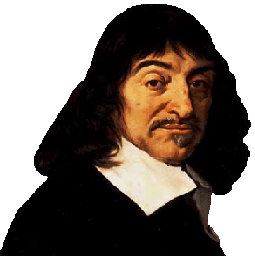
Scholars generally hold that the European Renaissance began in the Italian city state of Florance in Tuscany in the 14th century. The increase in commerce, artistic, and religious activity associated with the period from the 14th to the 17th century also brought increased scientific activity that eventually lead to what historians call the scientific revolution. Writers often associate the beginning of the scientific revolution with the publication of two important works: Nicolaus Copernicus' (1474-1543) death in 1543 marks the publication (in Germany) of his privately circulated manuscript called Commentariolus (Little Commentary) under the title De revolutionibus orbium coelestium (On the Revolutions of the Heavenly Spheres, published in 1543 at Nuremberg, Germany). The physician, Andreas Vesalius (1514-1564), publishes his seven volume text on anatomy called De Humani Corporis Fabrica (On the Fabric of the Human body, published in 1555). Both of these works challenge the traditional theories and figures in their areas. Copernicus forwards the heliocentric conception the the universe in contrast to Ptolemy. Vesalius challenges many aspects of the anatomical teachings of Galen. These works and many others served to create a tradition of deterministic mechanism in science. This tradition increasingly sought to understand all phenomena in terms of universal physical laws discovered through contolled empirical experimentation, even life and the mind. The French philospher, physicist, mathematician, anatomist Rene Descartes (1596-1650) painted the tension between the spiritual or immaterial world view and the mechanistic physical world view in stark contrast in his works, particularly his highly influential work Meditations on First Philosophy (1641).
Like
all thinkers of the time, Descartes is dualist as well as a scientist, mathematician, and philosopher--though those
endeavors are not particularly distinct at the time. He came to science
rather indirectly: Descartes attends a Jesuit school located at La Flèche,
France called Collège Royal Henry-Le-Grand in 1607. His graduation from
Henry-Le-Grand sees him earn his degree and license in Law at the University of
Poitiers in 1616. Descartes joins the army of the Dutch Republic for a brief time
in 1618, during which time he meets Isaac Beeckman, who
reignites his interest in physics and mathematics.
Descartes claims to have had dreams shortly thereafter which he interprets as a
divine sign that he should found a unified science of nature based upon
mathematics.
Descartes'
work, Meditations on First Philosophy
(1641), proves important for two reasons: (1) Because
as a scientist and mathematician, he brings the goal rigorous scientific
methodology and explanation to philosophical speculation regarding the mind.
For instance, Descartes defines the properties of mental and physical substance,
thereby further articulating the sorts of properties and causal connections that
ought to underlie any explanation of the mental.
Ironically, it is the emphasis on science and physicalism that inspires the climatic works on the mind with a strong epistemic stance. John Locke (1632-1704) writes my An Essay Concerning Human Understanding (1690) to flush out the corpuscularian philosophy (essentially the hypothesis that the physical world is composed of atoms and “the void” which he learns from the great chemist Robert Boyle) with regard to the mind. Like all British Empiricists, Locke seeks to understand the mind in order to more accurately understand and theorize about the nature, limits, and sources of knowledge. David Hume (1711-1776), shares Locke’s project of understanding the nature of the mind in order to understand the nature, sources, and limits of knowledge. However, reflection upon observations--as opposed to a particular ontological picture--drive Hume's theorizing in works like, A Treatise of Human Nature (1739-40) and An Enquiry concerning Human Understanding (1748). I come to the conclusion that empiricist theories of mind undermine one’s claim to knowledge of physical objects and causality.We both outline theories of mind that have representations and operations on those representations. Unlike Hobbes--but like Descartes--Locke's and Hume's model for representations are pictures. Locke and Hume view the mental processes underlying thought and reasoning as resulting from operations on ideas. Of particualr significance, Hume views human reasoning about the experiences as resulting from operations of association rather than by deduction. For example, Hume thought that cause and effect reasoning results from habitual associations between ideas because of their constant conjunction in experience. In the An Abstract of a Book lately Published: Entitled A Treatise of Human Nature etc. (1740) tells readers that,
| Tis evident that all reasonings concerning matter of fact are founded on the relation of cause and effect, and that we can never infer the existence of one object from another, unless they be connected together, either mediately or immediately... Here is a billiard ball lying on the table, and another ball moving toward it with rapidity. They strike; and the ball which was formerly at rest now acquires a motion. This is as perfect an instance of the relation of cause and effect as any which we know, either by sensation or reflection. (¶8-9) |
The third famous British Empiricist George Berkeley (1685-1753), differs from Locke and Hume in that his work emphasizes ontologial issues. Indeed, in his works, A Treatise Concerning the Principles of Human Knowledge, Part I (1710) and Three Dialogues Between Hylas and Philonous (1713), Berkeley argues against materialism in favor of a view called Idealism, in which nothing exists but minds and their ideas.
Thus, with Berkeley we see the three major classes of theories regarding the ontological nature of the mind and body. First, materialism (or reductive materialism) holds that there is only one type of substance, material substance. The mind and all mental properties result from modifications of the same substance as all other things, i.e., the mind = the body. Second, dualism (or substance dualism) holds that there are two distinct kinds of substance, mental substance and physical substance. The mind is a mental substance, while the body is a physical substance. Finally, idealism holds that there is only one kind of substance, mental substance, and all physical objects and properties are actually ideas and their properties. As well see soon, these basic positions have many permutations.
 |
 |
|
| John Locke (1632-1704) | David Hume (1711-1776) | George Berkeley (1685-1753) |
 |
 |
|
| Thomas Reid (1710-1796) | Immanuel Kant (1724-1804) |
The Twentieth Century
Substance Dualism
Despite
Kant's skepticism, scientific psychology does begin to develop. By 20th century concerns over how best to
understand and explain the mind’s physical origins drives philosophical
speculation regarding the mind, supplanting the emphasis on epistemology. Additionally, concerns arising from philosophical interests in language and
mathematics begin to pervade the philosophy of mind.
As noted above, each view--reductive meterialism, dualism, and idealism constitute categories of theoretical positions in which permutations exist. For instance, in the case of dualism philosophers commonly note three distinct positions: Descartes, held the most common position--interactive dualism. Interactive dualism holds that mental substance and physical substance causally interact with one another. Interactive dualism might seem like the only possibility. However, two other possibilities emerge if one denies that mental and physical substances interact. Such a denial might seem ridiculous given the apparent connection between mental phenomena and physical phenomena. For instance, if some one steps on your foot, a physical phenomena, you will likely experience a feeling of discomfort in your foot, a mental phenomena. However, Descartes' clarity and rigor in differentiating mental and physical substance, ironically, raises a significant challenge to interactionism.
Recall that mental substance is essential non-spatial, lacking all physical properties. Likewise, physical substance is essentially spatial, lacking all mental properites. If the mind and the body are fundamentally different sorts of stuff, one must ask, "How could these two substances possibly causal interact with one another?" For that matter, given that the mind is non-spatial, where could they possibly causally interact. It seems indubitable that the mind and the body interact with one another, and so interactive dualism must explain how such causal interaction could possibly occur. Philosphers have articulated many difficulties with interactive dualism, but most agree that the difficulties with causal interaction has to rank very high. In addition to difficulties with the very idea of inter-substance causation, another serious difficulty emerges almost immediately from dualistic interactionism. In a mechanistic, deterministic physical science, all changes in the physical would should (at least in principle) should be explicable by universally applicable purely mechanistic, deterministic physical laws. But, if mental substances and causal substances causally interact, mental causation renders universal purely mechanistic, deterministic physical laws impossible. Mental to physical cuasation will always fall outside purely physical laws.
One possible solution to this last worry involves denying interactionsim--at least in one direction. Epiphenomenalism is the view that changes in physical substances can causal mental phenomena, but that changes in mental substances cannot cause changes in physical substances or their properties. Thus, one can still hold that some causal connections exist between the mental and the physical, but mental causation will never violate universally applicable purely mechanistic, deterministic physical laws. While epiphenomenalism might allow for deterministic physical laws, it implies that mental phenomena never cause physical phenomena--violating the seeming obvious nature of mind-body interactions. Worse still, epiphenomenalism must explain why causation only runs from the physical to the mental, and not vice versa.
The second dualist solution to the problem of interaction also denies interactions. Parallelism is the view that mental and physical substances only appear to causally interact. Instead of causal interaction, mental and physical changes merely mirror one another, creating the illusion of interaction. One might find one anti-interactionism less plausible than the next. However, considering the difference between causation and correlation might make parralelism seem somewhat more plausible. The time on my watch may always correlate with the time on your watch, but no one supposes that our watches causally interact.
One can summarize the various substance dualistic positions in the following table:
|
Possible Substance Dualisms |
||
| Mental to Physcial Causation | Physical to Mental Causation | |
| Interactionism | YES | YES |
| Epiphenomenalism (mental) | NO | YES |
| Epiphenomenalism (physical) | YES | NO |
| Parallelism | NO | NO |
Physicalism
Substance Dualists seem to face a choice between difficult options: Epiphenomenalism and parallelism imply that the seeming robust causal interaction between mental and bodily phenomena is illusory. Interactionists, in contrast, face the daunting challenge of explaining how such different type of substances having such different properties can causally interact. Physicalism might seem to have an obvious advantage in that it does not suppose that the mental and the physical are radically different. However, this very strength presents the physicalist with a challenge. Specifically, mental properties do seem different from other sorts of physical properties. Indeed, many people find the idea that mental properties are just physical, mechanistic properties intuitively unpalitable. For instance, every physical object has mass, but only animals seem to be candidates for conscious qualitative experiences. Why, one might well ask, are only some physical objects candidates for mental properties? Similarly, mental properties seem qualitatively different from physical properties. How do mental properties arise from physical properties and processes?
The first answer to the sorts of questions was simply that mental properties were just physical properties. Such views are expressed by, for example, Aristotle when he claims that,
| ...their definitions ought to correspond, e.g. anger should be defined as a certain mode of movement of such and such a body (or part or faculty of a body) by this or that cause and for this or that end. (Book I, Part I, ¶6) |
However, most historical accounts trace type-type indentity theory to two papers "Is Consciousness a Brain Process?" by U.T. Place (1956) and "The 'Mental' and the 'Physical'" by Herbert Feigl (1958). The first attempt to systematically address the difficulties for physicalism is a position called Logical or Analytical Behaviorism. In general, most historians cite Gilbert Ryle's book, The Concept of Mind (1949), then Hempel's "The Logical Analysis of Psychology" (1935,1949). However, Hempel's article was published, though in French, over 14 years earlier. Both works are important because they share a common shift of emphasis that has continued to shape thinking about the mind in philosophy. Both Ryle and Hempel seek to defuse the seeming difficulties in understanding how mental properties arise from physical properties by arguing that the meanings of mental terms are exhausted by behavioral terms. Hempel tell readers,
| All psychological statements which are meaningful, that is to say, which are in principle verifiable, are translatable into statements that do not invovle psychological concepts, but only the concepts of physics. The statements of psychology are consequently physicalistic statements. (p.18) |
Similarly, Ryle asserts,
|
In this chapter I try to show that when we describe people as exercising qualities of mind, we are not referring to occult episodes of which their overt acts and utterances are effects; we are referring to those overt acts and utterances themselves. (p.25) |
While Hempel's aim is primarily scientific and ontological, Ryle's work is neither. Instead, Ryle's work is primarily a work in the analysis of the concepts of ordinary language. In both cases, however, the seeming difficulties associated with the equation of mental properties and physical properties are traced to an improper understanding of the true meanings of mental terms. Logical behaviorism faces two significant difficulties. On the one hand, the meanings of many mental terms seem essentially tied to qualitative subjective experience as opposed to the behaviors they cause. Thus, many people find the awfulness of pain essential to being in pain, but few find verbal demonstrations essential to being in pain. On the other hand, many mental properties such as aibohphobia (the fear of palindromes) seem not to have any definitive set of behvorial effects. Thus, a person paralized by curare will not exhibit the normal behavioral effects of pain when stabbed in the arm. However, it seems impropable to suppose that such a person feels no pain. Likewise, actors really do suffer for their art according to logical behaviorists. Similarly, the causes and effect of your belief that this text is remarkably dry cannot be determined in isolation. If you love dry and boring texts, you may read all night. If you are hungry, your belief may result in your getting a chocolate bar.
Theorists are exploring these difficulties in the technical literature even before Ryle publishes The Concept of Mind. However, Putnam's "Psychological Concepts, Explication, and Ordinary Language," (1957) and Chisholms "the implications for logical behaviorism of such technical problems.
Type-type behaviorism
Type-token behviorism
Functionalism
Computationalism
Beginning in the fifties with work by--among others--Place, Feigl, and Smart by John Smart and Ullin Place myself, Hilary Putnam (1926-), and climaxing in the early eighties, philosophers converge upon the basic explanatory schema of the CTC/RTI. My own work builds upon work by logicians and mathematicians as well as philosophers of language and science. Work by Ned Block (1942-), Robert Cummins (1948?-), Dan Dennett (1942- ), Jerry Fodor (1935-), and John Haugeland (1945-) further articulate the structure of explanations in Cognitive Science. The resulting picture is beautifully articulated in their work.