|
|
 |
|
|
|
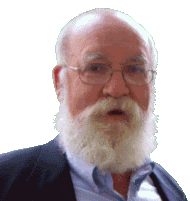
Paul Thagard |
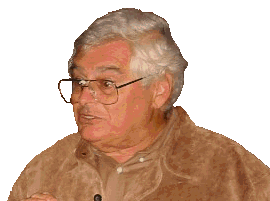
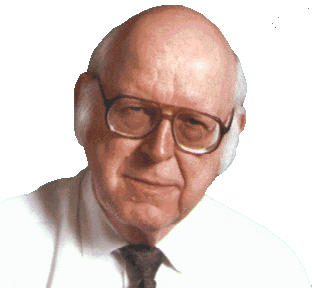
Jerry Fodor (1935- ) | Daniel Dennett (1942- ) | John Haugeland (1945- ) |
 |
|
 |
|
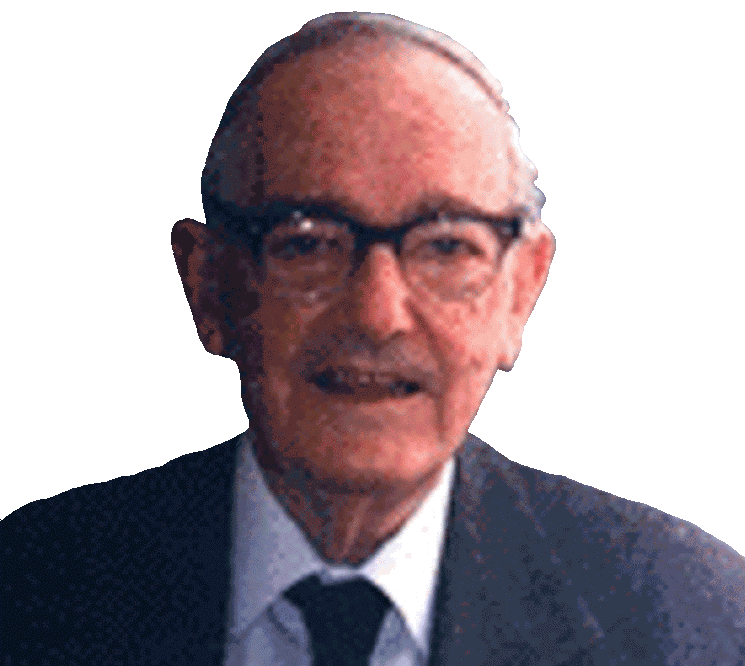
| Alan Newell (1927-1992) |
Herbert
Simon (1916-2001) |
Robert Cummins (1953- )
|
|
Introductory
Lectures: The Nature and History of Cognitive Science
It
All Starts With Questions
All
human beings spend some time wondering about the nature of the world, their own
nature, and how the two fit together. Asking
questions marks the beginning of rational inquiry.
However, questioning in itself is not inquiry.
Inquiry requires adopting a framework within which one can use answers to
certain questions as a basis for answering others.
For example, science has been made possible by adopting a framework in
which researchers address questions regarding the nature of elements and
phenomena in the world through controlled, repeatable experimentation.
As we will see, cognitive science seeks to answer many questions, working
within a framework that adopts answers to certain other questions.
The answers proposed by cognitive scientists to central questions
regarding the mind have emerged from the development and interactions of its
individual disciplines. These
answers distinguish cognitive science’s approach to the mind from the
approaches of its historical predecessors. The
most fundamental and oldest questions regarding the mind concern its essential
nature—what is the mind-- and its relationship to the physical world.
Mentality:
What is it to have a mind?
Are the mind and the body distinct entities?
How do the mind and the body interact?
What elements of the body are associated with the mind?
Closely
related to questions about the mind’s essential nature are questions about the
nature of conscious mental experiences and their relationship to mental
functioning.
Consciousness:
What is the nature and role of consciousness in mental abilities?
Does consciousness drive or even exhaust mental abilities?
How do conscious qualitative experiences arise in the brain (or do they)?
Is conscious experience divisible or a unified whole?
Is our sense of the contents of our
conscious experiences accurate?
Can we bring all of our mental operations into
consciousness?
Like
our conscious sensations, thinking and problem solving are among the most
salient features of the mind. Some
of the most central questions for cognitive scientists have been how best to
characterize and understand thinking and problem solving.
Cognition:
What is cognition?
What role should cognitive capacities play in a scientific account of the mind?
What is the nature of cognitive capacities?
Do animals and humans have similar or even identical mental capacities or
processes?
Like
our problem solving abilities, many of our conscious experiences and mental
processes seem to have intentionality. That
is, our mental states and processes are about (refer to) objects, properties,
and events in the world.
Intentionality:
How does the world ‘get into’ the mind?
How does the mind gain, store and organize, and ultimately utilize knowledge
about the world?
Finally,
cognitive scientists propose answers to questions about how to answer our
questions about the mind and its relationship to the physical world.
Methodology:
How ought one study and explain mental abilities?
Need one posit mental entities to explain the mind?
Cognitive Science is Interdisciplinary
It
is platitudinous to say that cognitive science is an interdisciplinary field.
In this first set of lectures I try to spell out what makes cognitive
science an interdisciplinary field. Specifically,
I will suggest that the various disciplines of cognitive science have converged
upon a general explanatory schema with regard to particular set of phenomena.
These lectures provide students will a relatively superficial history of
that convergence for the oldest and most central disciplines within cognitive
science; philosophy, psychology, linguistics, neuroscience, computer science,
and mathematics. Students should not
suppose that these are the only disciplines within cognitive science, nor should
they suppose that all the work in these disciplines falls under the rubric of
cognitive science. For example,
cognitive anthropology cognitive ethology, comparative psychology, and
neuroeconomics also explore human and/or animal cognition.
Similarly, not all areas of computer science, or for that matter,
artificial intelligence, seek to explain human cognition.
Finally, students should not assume that the below-outlined
convergence towards an explanatory schema is completely homogenous within
cognitive science, or that theorists agree about every aspect of the schema.
All introductory courses necessarily tradeoff a degree of descriptive
accuracy in order to enhance the simplicity and comprehensiveness of the
material presented. This course is
no different in that respect.
Convergence
Towards What?
Cognitive scientists, as the name suggests, focus much of their efforts on understanding explaining cognition, especially human cognition. One of the central theses adopted by a majority of researchers in cognitive science characterizes the nature of cognition and prescribes a particular schema for explaining cognitive abilities. The characterization of cognition driving a vast majority of research in cognitive science has several similar, though not necessarily equivalent, elaborations. For instance, Paul Thagard 1 explicates cognition using the acronym CRUM, the Computational Representational Understanding of Mind. Jerry Fodor 2, 3 and others use the acronyms RTM for Representational Theory of Mind and LOT for the Language of Thought. John Haugeland4, 5 characterizes this approach in terms of Semantic Engines and Automatic Interpretable Formal Systems. Daniel Dennett6 refers to the approach as the Intentional Stance. Allan Newell and Herbert Simon7 express these ideas in terms of Physical Symbol System Hypothesis or PSSH.
|
|
|
|
|
|
Paul Thagard |
Jerry Fodor (1935- ) | Daniel Dennett (1942- ) | John Haugeland (1945- ) |
|
|
|
|
|
| Alan Newell (1927-1992) |
Herbert
Simon (1916-2001) |
Robert Cummins (1953- )
|
|
I prefer the characterization Robert Cummins8
offers: CTC/RTI, for the Computational Theory
of Cognition and the Representational Theory of Intentionality.
But, what do all of these acronyms mean?
To
cognize is to become cognizant of something, especially to perceive, become
consciously aware, or, most importantly for this course, to know.
The core phenomena that cognitive science has traditionally sought to
explain are instances of cognition, and cognitive science characterizes
cognition as a process in which information about the object, property, or event
become known because the cognizer represents that object, property, or event.
Thus, one can formulate the central explanatory principles of cognitive
science as follows:
|
The Computational Theory of Cognition holds that cognition is the computation of complex functions on representational states, where computation consists in performing information processing operations defined over the syntactic structures (kinds) of representational states. |
|
The Representational Theory of
Intentionality asserts that mental states
are about the world (have content) in virtue of a representation relation
holding between the represented element of the world and the particular kind of
mental state. |
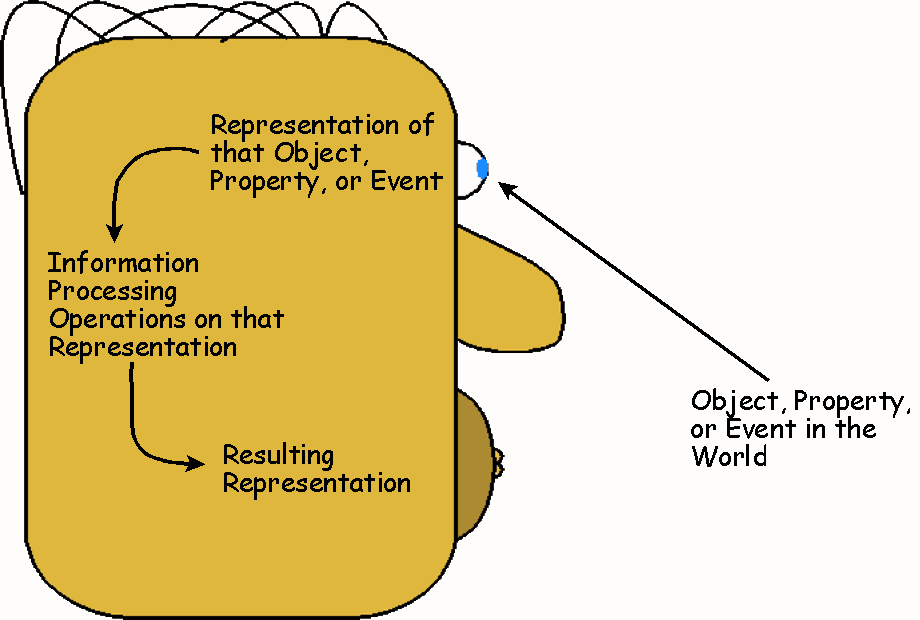 |
The first diagram displays the basic relationships posited by cognitive scientists during an act of cognition. Objects, properties, or states in the world are represented by the cognizer. Information processing operations act upon the representation to transform it so as to create a representation of the solution. |
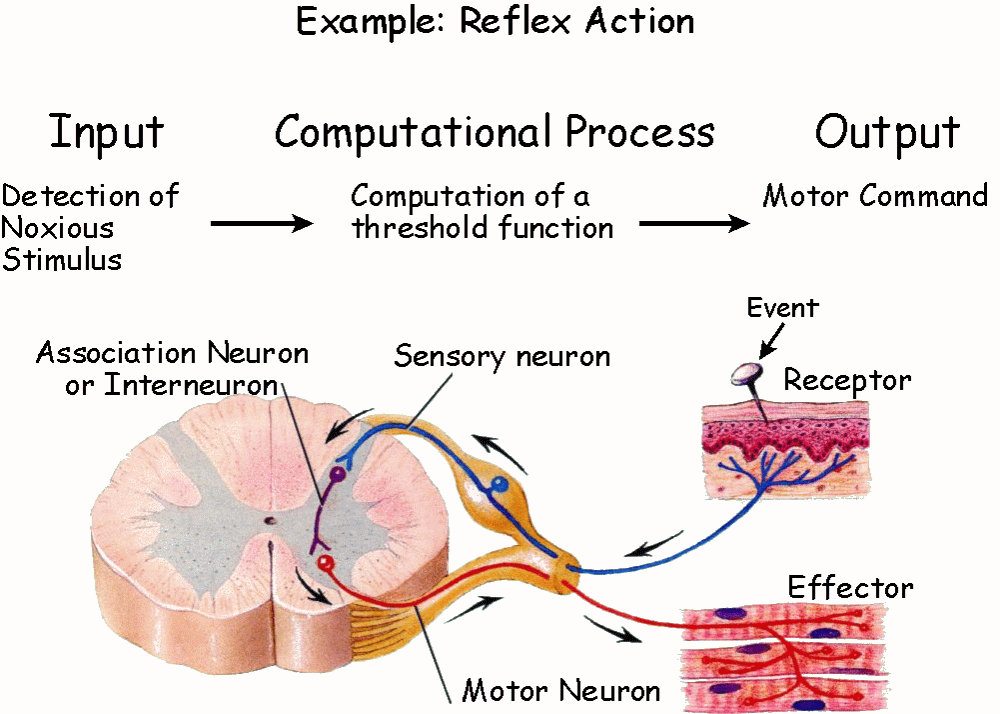 |
The next diagram illustrates these relationships in action by diagramming the reflex arc. Here the event of cellular damage causes a change in the receptors of the sensory neuron, representing damage. This representation is transferred by the sensory neuron into the spinal cord. In the spinal cord an association neuron processes the representation of damage from the sensory cell. If the representation is sufficiently strong, i.e., the dammage is sufficiently great, then the association neuron fires, signaling to the motor neuron that it should move. |
In
large part, the entire course explores theorists’ attempts to expand upon and
apply these two theses (CTC/RTI). In
the next few lectures we will see how the various disciplines of cognitive science
came to converge upon particular mental phenomena as the central and the primary
areas of cognitive science research. More
specifically, we explore how researchers came to conceive of perception,
attention, memory, learning,
problem solving, and language as information
processing tasks, and paradigm cognitive processes.
1.
Thagard, P. Mind: Introduction to Cognitive Science (MIT Press,
Cambridge, MA, 2005).
2.
Fodor, J. The Language of Thought (Harvard University Press, Cambridge,
MA, 1975).
3.
Fodor, J. RePresentations: Philosophical Essays on the Foundations of
Cognitive Science (MIT Press, Cambridge, MA, 1981).
4.
Haugeland, J. in Mind Design: Philosophy, Psychology, and Artificial
Intelligence (ed. Haugeland, J.) (1981).
5.
Haugeland, J. Artificial Intelligence: The Very Idea (MIT Press,
Cambridge, MA, 1985).
6.
Dennett, D. Brainstorms (MIT Press, Cambridge, MA, 1978).
7.
Newell, A. & Simon, H.A. Computer Science as Empirical Inquiry:
Symbols and Search. Communications of the
ACM 19, 113-126 (1976).
8.
Cummins, R. Meaning and Meantal Representation (MIT Press, Cambridge, MA,
1989).