The Study Habits Inventory

Print and fill out the following questionnaire.  You will not turn in the questionnaire, nor will you need to report the numeric score.  So, you will benefit most from this questionnaire if you answer honestly.  To start, evaluate your study habits on a scale of 0-30, evaluate your reading habits on a scale of 0-25, and evaluate your writing habits on a scale of 0-10, where the highest number is the best, and 0 is the worst.  Write down each number.  Answer the questions below as honestly as possible.  Click on the link to see the values for each answer.  Add up your scores based on your answers, and compare them to your initial evaluations.  Were they higher or lower than you expected?  Read each of the explanation sections (below), and try to figure out what you do well and what you might try to improve.  Choose a specific suggestion in each section (studying, reading, and writing) that you will try to include in your future studying, reading, and writing.   Once you have completed the inventory AND carefully reviewed the key (link at bottom), log on to beachboard and complete the study habits inventory assignment.


Studying Questions Points

1.) I study course material... (choose one)

a.) several times a week, even if for short time periods.

b.) once a week.

c.) only before the test.


a.) +2

b.) +1

c.) +.5


2.) I study the lecture slides.... (choose all that apply)

a.) before the lecture.

b.) after the lecture.

c.) before the test.

d.) never.


a.) +1

b.) +1

c.) +.5

d.) 0


3.) When I study, I ... (choose all that apply)

a.) read my notes, read the lecture slides, or read the assigned readings.

b.) try to write answers study questions, and then check them against my notes, the lecture slides, and/or the readings.

c.) create diagrams or draw arrows between key concepts.

d.) try to explain the ideas and arguments out loud or to my friends.

e.) try to generate examples of key ideas from my own experience.

f.) none of the above.


a.) +1

b.) +2

c.) +2

d.) +2

e.) +2

f.) 0


4.) During lectures and small group meetings I... (choose all that apply)

a.) ask questions to help me better understand the material.

b.) take notes by copying the slides.

c.) take notes on the lectures slides or lecture outlines.

d.) listen for clarifications and examples that are not on the lecture slides.

e.) write or draw connections between ideas, slides, or key words.

f.) none of the above.


a.) +2

b.) +.5

c.) +1

d.) +2

e.) +2

f.) 0


5.) If I have trouble understanding material in the course, I...

a.) search the internet looking for alternative materials.

b.) ask clarificatory questions about the material in class.

c.) consult the materials cited by the readings or lecture.

d.) look for articles by the figures discussed in class using one of the library databases. 

e.) go to office hours.


a.) +0

b.) +2

c.) +2

d.) +1

e.) +2


Total points: Possible Points: 30

Explanation:

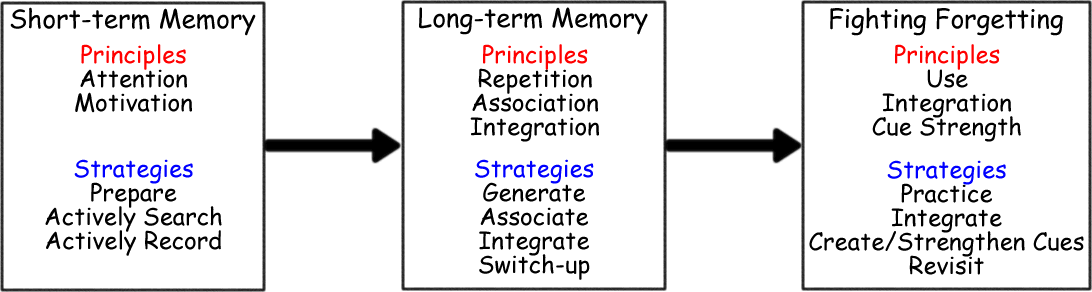
There is no one-size-fits-all set of practices for how best to study.  However, knowing just a little bit about how your brain works will help you to maximize your study efforts.  Many factors affect memory including mood, environment--even time of day.  I'll briefly discuss the three important elements of long-term learning and memory and relate them the questions above.  Memory can be usefully divided into (1) short-term (also called immediate or working memory) and (2) long term memory.  To learn information you must first get that information into short-term memory.  In order to retain that information you must transfer (consolidate) that information into long-term memory.   Many discussions of memory end here.  Unfortunately, this is a horrible omission!!  What these discussions leave out is that (3) your brain also forgets!!  This shouldn't surprise anyone.  We've all experienced situations where we learned something, only to be unable to recall it latter.  For instance, can you remember all your teacher's names from junior high and elementary school?  In order to study efficiently, you need to address all three elements of memory.  So, I'll discuss each in turn

Short-term memory
If information doesn't get into short-term memory, then you're unlikely to remember it at all.  Two factors can improve your ability to get information into short-term memory, and to get the right information into short-term memory; attention and motivation.  You can think of attention as a spotlight that allows you to see wherever it shines.  If you don't focus your attention on information, it's  unlikely to enter into short-term memory, just like it's unlikely you'll see anything when you walk into a dark room unless you shine your flashlight on it.  So, just coming to class doesn't mean that you'll learn something--especially if you are surfing the web or talking with friends, etc..  The best way to focus attention is through motivation.  If you come to class to learn the material, even better, if you come to class with specific learning objectives, then you help yourself to focus attention on the information you need to learn.  For this reason, I emphasize taking an active role in studying by (a) preparing yourself to learn, (b) actively looking for information, and (c) rehearsing and recording that information in ways that require you to attend to its content.


Long-term memory
In order for you to store information in long-term memory your brain must literally move it from one part of your brain another part of your brain and create long-term structural changes in your brain.  Not surprisingly, this process takes time.  Thus, while some memories seem to form rather quickly, most memories must be created by effort and time.  This process is often called memory consolidation.  Three important results can help you to better facilitate memory consolidation.  Your brain works hard to consolidate your memories while you sleep.  So, (a) it is best to study before going to bed or before doing something that isn't very intellectually demanding.  (b) Scientists have long known that repetition helps your brain to consolidate information into long-term memory, so studying often is a good idea.   Repetition, however, is the blunt instrument of learning and memory--mere repetition helps, but the effectiveness of simply repeating information is not that dramatic for each repetition, and its effectiveness decreases the more you do it.  (c) Consolidation is greatly facilitated by actively drawing connections between ideas, integrating the information with your own experiences through rephrasing it in your own words and your own examples, rehearsing information through different modalities, (visually, reading, writing, speaking, etc..).  A particularly good way to rehearse information is by first trying to recall or recreate the information, then comparing your results to your notes or the course materials.  You can summarize these points by the keywords:  generate, associate, integrate, and switch-up.


Forgetting
There are many theories about forgetting and how/why it occurs.  However, for our purposes we can note features that increase your ability to recall information for long periods of time. 
(a) Practice: It turns out that people who learn and use their memory more often start to learn faster and better than people who do not exercise these capacities.  (b) Integrated or meaningful storage: If you attempt to learn information by integrating it with what you already know or by making associations between ideas, this facilitates better recall for longer periods.  (c) Retrevial cues: Some theories suggest that failing to recall information is often a failure to retrieve the information using the best or strongest cues or prompts.  For instance, you might not be very good at telling me if a person was in your sixth grade class when I ask you by listing names, but your performance might increase if I show you pictures instead.  One strategy to help with retrieval cues is to structure your reviews by trying to retrieve the information and then going back and working on those connections and ideas for which you are weakest in your recall.  Another strategy is to associate information with a specific cue to facilitate recall.  For example, diagrams or Mnemonics (creating poems or acronyms to summarize key points).  (d) Finally, revisiting the material in spaced intervals over a longer period of time facilities recall and length of recall.


Here is a learning and memory summary chart:


Reading Questions Points

1.) I read the assigned readings... (choose all that apply)

a.) before the lecture.

b.) after the lecture.

c.) before the test.

d.) never.


a.) +2

b.) +1

c.) +1

d.) 0

2.) I read the assigned readings... (choose all that apply)

a.) never.

b.) once.

c.) more than once.


a.) 0

b.) +1

c.) +1


3.) When I read the course material I... (choose all that apply)

a.) start by looking over the material noticing headings, sub-headings, bolded text, diagrams, etc..

b.) read the introductory and summary paragraphs.

c.) use a highlighter and/or make textual notes.

d.) try to outline the text as I read it.

e.) just try to read it.

f.) none of the above.


a.) +2

b.) +2

c.) +2

d.) +2

e.) +1

f.) 0


4.) When I come across a word or phrase in the text with which I'm unfamiliar, I... (choose all that apply)

a.) just continue on, or stop reading.

b.) try to determine its meaning from the context of the passage.

c.) look up the meaning in the lexicon or other resource.

d.) determine the word's meaning and review the sentence or passage so that I'm sure I understand it.

e.) determine the word's meaning and then make a textual note about the meaning.

f.) determine the word's meaning and then rewrite the sentence in my own words.

g.) make a note of the word and its meaning for review.


a.) 0

b.) +1

c.) +1

d.) +2

e.) +2

f.) +2

g.) +2


Total points: Possible Points: 25

Explanation:

People often fail victim to two mistakes in thinking about reading.  (1) People tend to think of reading as an activity that is separate from studying.  (2) People tend to think that reading comprehension should occur as you read, without any preparation, active organization, or reflection and rehearsal.  Reading comprehension is greatest when the reader surveys the work first and creates a road map or outline of the text, followed by reading the text actively to improve and elaborate the original outline.   Consistent with what I outlined above about learning and memory, I encourage people to follow the following advice about reading philosophy:

(1.) Ask
        You should always ask and attempt to answer the following questions when reading a philosophy paper:
                (A) What is the problem to which the author addresses the article?
                (B) What is the significance of the problem in the author's eyes?
                (C) What is the author's solution or thesis regarding the problem?
                (D) What reasons does the author offer in support of their solution or thesis?

(2.) Answer
        Before you read the article in detail, you should attempt to answer the questions above.  There are a couple of things you might find helpful:
                (A) Read the first and last paragraph as well as an abstract if available, these are usually summaries of the article.
                (B) Read the section headings if available and relate them to the outline given in the first and last paragraphs.
                (B) If you find words in the abstract or opening/closing paragraphs that you do not understand, look them up using the lexicon.
                (C) Look at the course slides, they are detailed--though by no means complete--summaries of what I think one ought to take away from the article.

(3.) Read
        Once you've got the general idea of the article and familiarized yourself with any specialized vocabulary, read the article carefully.  It is best if you try to read
        it--or parts of it--more than once. 


(4.) Rephrase
        After you have read the article you should try to rephrase or organize the material in your own words or using your own summary devices.  There are a couple of
        things you might find useful:
                (A) Make an outline or draw diagrams.
                (B) Make your own notes on the lecture outline (in slides), including things like drawing arrows between points or adding your own "translations"
                (C) Try to find examples of the article's ideas and arguments from your own life.

(5.) Revisit
        You should look back over your original notes and see how your original take on the article has changed.  You should also try to revisit your notes several times
        throughout the course.

(6.) Ask
        You will probably still have questions about the article or how the lecture approaches the article.  Make a note of them and ASK them in class.


Writing Questions Points

1.) In writing an answer to an in-class exam question, I... (choose all that apply)

a.) start by carefully reading the entire question, marking important or familiar words and concepts.

b.) start writing after reading the first sentence or prompt.

c.) read all the questions, and start writing on the question with which I am most comfortable.

d.) read the question, then consider how the question relates to the lectures on that topic. 


a.) +1

b.) 0

c.) +1

d.) +1


2.) In writing an answer, I... (choose all that apply)

a.) work out every detail of the answer in my head before writing.

b.) work out a general outline of my answer before writing.

c.) proceed through the question from prompt to prompt, writing the answer as I read each prompt.


a.) 0

b.) +1

c.) 0


3.) In writing an answer to the question, I... (choose all that apply)

a.) try to illustrate my understanding of the material through the use of examples.

b.) assume the professor knows what I'm talking about.

c.) define all course-specific terms as part of my answer.

d.) write my answer as a self-contained, concise essay any intelligent person could read and follow.


a.) +1

b.) 0

c.) +1

d.) +1


4.) After writing an answer, I... (choose all that apply)

a.) move on to the next question.

b.) read the answer looking for content errors, grammar errors, and unaddressed prompts.

c.) read the answer twice; once for content errors and missing information, and once for grammar, spelling, and etc..

d.) read the answer, checking the answer against the question and my rough outline for completeness and correctness.


a.) 0

b.) +1

c.) +1

d.) +1


Total points: Possible Points: 10

Explanation:

Assuming that you've studied, writing a good answer to a question has four steps.  (1) The first step in writing a good test answer occurs long before you get the test.  Writing is a skill.  You can improve your writing, just as you can improve your jump shot, by focused practice.  The more often you write, the more often you take time to improve your writing, the easier writing will become, and the better you will write.  (2) The second step to writing a good answer occurs before you start writing; you need to build a road map for your answer using the question.  As I said in lecture, a good test question provides you with a road map for a good answer.  You should always start your writing by first carefully reading the question, and using it to create a rough outline for your answer.   You shouldn't try to write the complete, detailed answer in your head, you should just know the general path you are going to follow.  You can write out your outline or do it in your head, but I find that it is best if you write it out.  (3) Follow your road map in writing your question.  Once you have created a road map for your answer, you should write it out.  Again, don't try to write a complete and perfect answer.  Writing is a highly demanding cognitive task.  No one writes perfect, error-free prose all the time.   Instead, you should breakdown your writing so that you're not trying to do everything all at once.  (4) Refine your answer.  Once you've generated your answer you should go back and refine it.  I encourage people to reread their answers twice, once looking for content issues, and once just looking for grammar and spelling issues.  In refining content, it helps to compare your answer to the road map you created to check for completeness.  You should also try to keep your writing goal in mind as your work through your answer.  In writing test answers, your goal is to write a concise, self-contained, and complete answer that anyone might read and understand.  In general, I have found that it helps to read your writing aloud when you check for grammar and spelling issues.  In an in-class test, you can't really read aloud.  However, here's another trick you might try: read your answer backwards.  Reading backwards forces your your brain to consider the structure of sentences instead of content.  You don't believe me?  Read the last few sentences of this explanation from end to beginning and see if you don't find the mistake in one of them.

The lecture slides from the test taking lecture give you a systematic process (a-i) for carrying out steps (2)-(4).  In doing your test answer revisions, I have you follow those steps.