


|
|
close window
|
|
||
|
||
 |
Your credit score is 671 | |
| Based on your credit report data, this is a numerical depiction of your creditworthiness. | ||
 |
||
|
|
Your credit ranks higher than 55% of the population | |
| Based on your credit score, this is how your credit standing compares to the rest of the nation. | ||
 |
||
|
|
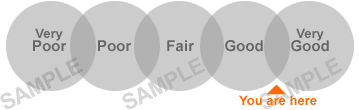
Your creditworthiness falls between Good and Very Good | |
| Based on your credit score, this is how you may be viewed from a lender's perspective. | ||
|
||
|
| Your Credit Score Analysis |
|
Background |
|
Credit Bureaus track your
personal credit history in a customer record. The customer record can
then be used to generate a credit score. It is advantageous to have a
higher score because there is greater chance of being qualified for
additional credit or the loan that you need for that new house or car.
It is important to note that when lenders consider a loan or credit
application, additional information is usually required for making
credit decisions. A creditor will usually ask for information like your
monthly income, employment history, and your current outstanding debts
to make an assessment as to whether or not you are capable of repaying
your loan. |
|
Summary |
|
Given that you have a high
credit score, lenders should be able to conclude that you are capable
of repaying your debts. This would then enable lenders to provide you
with better interest rates and loan offers. Credit cards may be harder
to obtain because lenders still see room for improvement. To improve
your credit score, continue to pay your debts on time. Lender offers
will differ based on the attribute information you provide concerning
your monthly income, employment history, and monthly debt. This
information will aid in the determination of whether you receive an
excellent offer, or just a respectable offer. |
|
Explanation |
|
There are several factors taken
into account that help determine your credit score. The factors making
the largest impact are listed below. Remember that these factors vary
in how strongly they impact your credit score. For example, if you have
a very high credit score, the negative factors in your analysis are
likely to have a small impact. For very low credit scores, the opposite
is true in that negative factors have a very large impact on your
credit. |
|
Here are the top factors that make your score lower: |
|
|
| Additional Information |
|
The TransUnion TransRisk
New Account Credit Score is provided to help you better understand how
lenders view your credit report. It is not an endorsement or a
determination of your qualification for a loan. Lenders use credit
scores to help determine whether or not you are a good candidate for a
loan and what interest rate you will pay. However, each lender has
specific underwriting standards, so you should not assume that you will
receive the same evaluation from each lender. As part of the
underwriting process, they will incorporate additional information you
provide and may obtain references. In addition, even if you are
approved, the terms and conditions of loans vary from lender to lender.
The information used to determine your credit score comes from
TransUnion, one of the major credit bureaus. Credit reports are a
compilation of credit information that is reported to the bureaus by
the various lending institutions with which you have accounts. The
information contained in your report reflects the latest information
provided. If you recently made a payment, opened a new account, or
authorized an inquiry, it may not yet be reflected in the credit report
you receive. Likewise, it will not be reflected in your credit score.
Also, disputed items are not incorporated in the assessment of your
credit score. Your credit score will change each time new information
is captured in your record. TrueCredit is not connected in any way with
Fair, Isaac and Company; the credit score provided here is not a
so-called FICO score. The credit scores of TransUnion may not be
identical in every respect to any consumer credit scores produced by
any other company. |
